

Why Living on Mars in Our Lifetime Is Likely Impossible
Living on Mars in our lifetime is likely impossible for most people because survival would require reliable radiation shielding, life support, food systems, medical care, transportation, and settlement infrastructure.
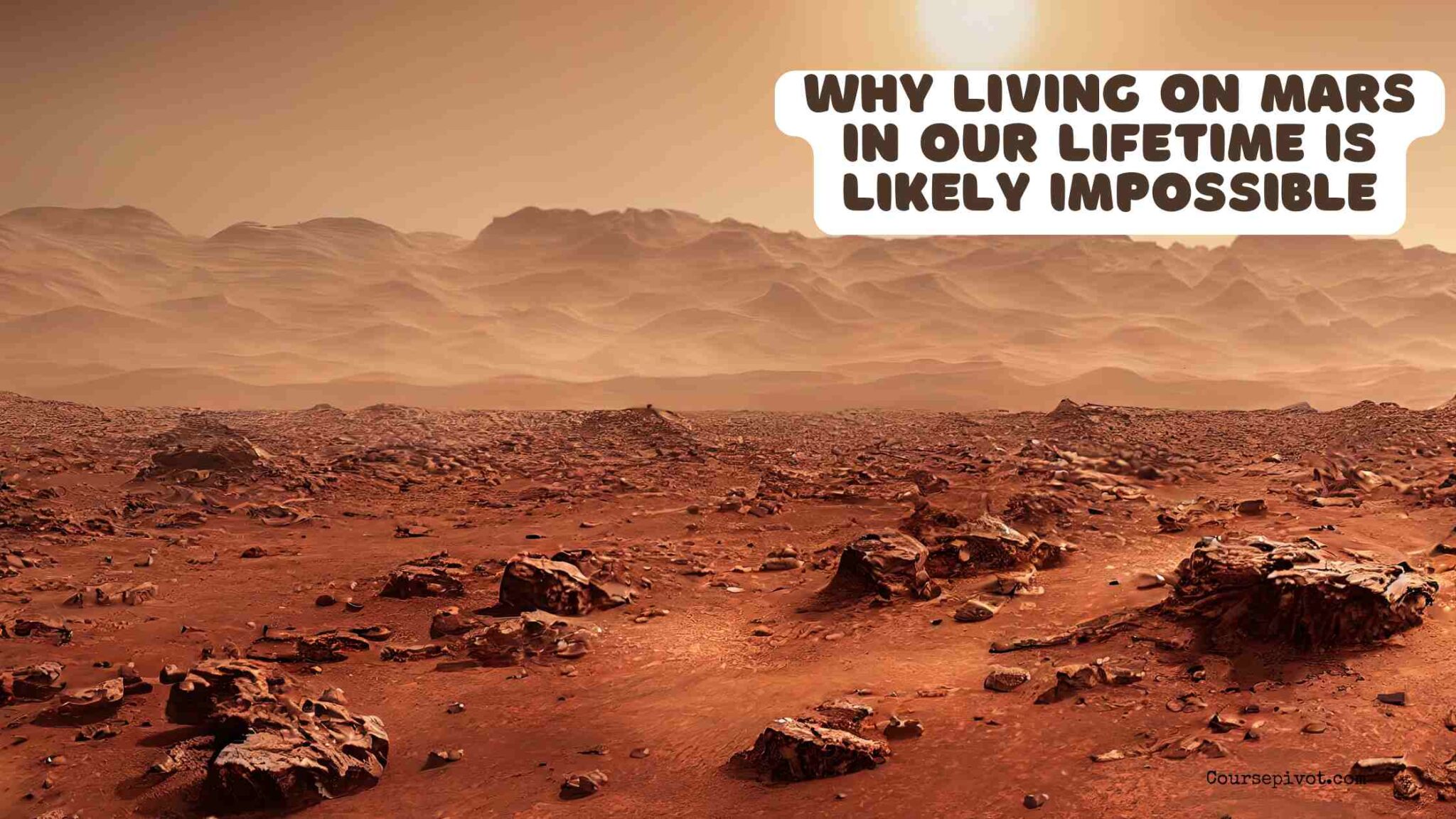
Living on Mars sounds like the next great chapter of human exploration. The idea is exciting: a red planet settlement, domed habitats, greenhouses, rockets landing on dusty plains, and people building a second home beyond Earth.
But visiting Mars is not the same as living there. A short crewed mission would be difficult enough. A permanent or semi-permanent civilian settlement would require technology, medicine, energy systems, food production, transportation, and social planning that are far beyond what we can reliably operate today.
The main reason living on Mars in our lifetime is likely impossible for most people is that every basic human need on Mars would have to be engineered, protected, repaired, and resupplied in one of the most hostile environments humans have ever tried to enter.
That does not mean humans will never reach Mars. NASA and other space organizations continue to prepare for future crewed missions. It means that “astronauts may visit Mars” and “ordinary people may live safely on Mars” are two very different statements.
Visiting Mars Is Not the Same as Living There
A Mars mission can be planned around a limited timeline. Astronauts can train for years, carry specialized equipment, accept higher risk, and return home after completing the mission. Even then, the trip may last many months each way, and the total mission could take years.
Living on Mars is a much larger problem. A settlement has to work every day, not just during a carefully planned mission window. People need breathable air, clean water, food, power, heat, medical care, communication, sanitation, radiation protection, emergency repair systems, and psychological support.
On Earth, these systems are distributed across an entire planet. If your water system fails, there are plumbers, replacement parts, supply chains, roads, hospitals, and other communities nearby. On Mars, failure is not an inconvenience. It can become life-threatening.
That is why the word “living” matters. A few astronauts working inside a research habitat for a limited mission is not the same as families, workers, students, and communities building a normal life there.
Mars Has Almost No Natural Protection
Earth quietly protects us all the time. Its thick atmosphere helps block harmful radiation, burn up many incoming objects, and hold heat. Its magnetic field helps shield the planet from charged particles from the Sun. Its air pressure allows liquid water to exist easily at the surface.
Mars does not offer that kind of protection. Its atmosphere is extremely thin and mostly carbon dioxide. The surface pressure is far too low for humans to survive without a pressurized suit or habitat. The planet also lacks a strong global magnetic field, which means radiation from space can reach the surface more easily.
Temperature is another challenge. Mars can be bitterly cold, and temperatures can swing widely. Equipment, seals, batteries, pipes, suits, and habitats would need to survive constant stress from cold, dust, radiation, and mechanical wear.
On Earth, the environment gives humans a generous safety margin. On Mars, the safety margin has to be built by engineers.
Radiation Is a Major Barrier
Radiation is one of the hardest problems for long-term Mars living. Space radiation can come from galactic cosmic rays and solar particle events. On Earth, our atmosphere and magnetic field reduce much of this exposure. On Mars, future residents would need artificial shielding.
Radiation can increase cancer risk, damage tissues, affect the central nervous system, harm the cardiovascular system, and create other health risks. A short mission already has to manage exposure carefully. A long-term settlement would have to protect people for years or decades.
Heavy shielding can help, but shielding creates new problems. It adds mass, and mass is expensive to launch and land. Some plans imagine using Martian soil, underground habitats, lava tubes, water, or special materials as protection. These ideas may be promising, but they are not yet proven as a complete daily living system for a growing population.
Radiation is especially difficult for children, pregnancy, and long-term health. A true settlement would need to answer questions about reproduction, child development, lifelong exposure, and emergency care in ways that are ethically and scientifically difficult to test.
Life Support Must Work Almost Perfectly
Humans need air, water, food, temperature control, waste management, and disease control. On Mars, all of those must be managed inside closed or semi-closed systems.
The International Space Station already recycles water and manages air, but it is close to Earth compared with Mars. It receives regular resupply missions. If a major system breaks, astronauts can sometimes return home relatively quickly. Mars is much farther away, and help would not arrive quickly.
For Mars living to become realistic, habitats would need highly reliable life-support systems that can run for years, repair themselves when possible, and be fixed with parts available on Mars. That means water recovery, oxygen production, carbon dioxide removal, humidity control, temperature regulation, filtration, and backup systems all need to work together.
There is little room for error. If a greenhouse fails, a water recycler breaks, or a carbon dioxide scrubber stops working, the settlement needs replacement parts, trained technicians, redundant systems, and enough stored supplies to survive the emergency.
This is why Mars living is not just a rocket problem. It is also a plumbing, farming, medical, electrical, mechanical, and logistics problem.
Food and Water Would Be Hard to Produce
Mars has water ice, and future missions may be able to use local resources. But “water exists on Mars” does not mean water is easy to access, purify, store, and use at settlement scale.
Water may be underground, frozen, mixed with soil, or located far from the best landing sites. Extracting it would require power, mining equipment, heating systems, storage tanks, purification systems, and maintenance. Every step must work in low pressure, extreme cold, dust, and radiation.
Food is just as difficult. A Mars settlement cannot depend only on packaged meals forever. Long-term living would require reliable food production. That means controlled agriculture, artificial lighting or filtered sunlight, nutrients, water recycling, pest control, plant disease control, and backup food reserves.
Martian soil is not ready-made garden soil. It lacks the living organic ecosystem found in healthy Earth soil and may contain toxic compounds such as perchlorates. Growing food would likely require treated growing media, hydroponics, aeroponics, or carefully engineered systems.
Students interested in environmental systems can connect this challenge with broader questions about sustainability, resource limits, and human survival. This article on future career fields in environmental science explores related fields that may matter for life-support and planetary protection research.
Low Gravity Could Change the Human Body
Mars gravity is about 38 percent of Earth’s gravity. That is stronger than the Moon’s gravity but much weaker than what the human body evolved for.
Astronauts in microgravity can lose bone density, muscle strength, cardiovascular conditioning, and balance without exercise and medical monitoring. Mars is not zero gravity, but scientists still do not fully know what decades in partial gravity would do to the body.
Would children grow normally in Mars gravity? Would pregnancy be safe? Would the heart, bones, eyes, immune system, and brain develop normally? Could people return to Earth after years on Mars without serious health problems?
These are not small details. A real settlement is not successful just because adults can survive for a short mission. It must support healthy bodies over long periods of time.
Until partial-gravity biology is better understood, large-scale Mars living remains speculative.
Distance Makes Every Emergency Harder
Mars is not just far away. Its distance from Earth changes constantly as both planets orbit the Sun. Depending on their positions, communication signals can take several minutes to more than 20 minutes one way.
That delay means no live conversation during emergencies. A doctor on Earth cannot guide a procedure in real time. Engineers cannot instantly troubleshoot a life-support failure. Families cannot communicate normally.
Travel windows also matter. Rockets cannot simply leave for Mars at any time with equal efficiency. Missions are usually planned around favorable alignments between Earth and Mars. That makes rescue and resupply far more complicated than sending supplies to a remote place on Earth.
Medical emergencies are especially serious. A Mars settlement would need doctors, surgical ability, medicines, diagnostic tools, quarantine plans, mental health support, dental care, injury treatment, and long-term disease management. It would also need ways to handle problems that no one predicted.
On Earth, modern life depends on deep networks of support. Mars would begin with almost none of them.
Cost and Scale Are Enormous
Even if the science works, the cost and scale remain enormous. A settlement would need launch vehicles, landing systems, habitats, power plants, spacesuits, rovers, spare parts, medical systems, food systems, mining tools, communication networks, and trained crews.
Landing heavy equipment on Mars is difficult because the atmosphere is thick enough to cause heating but too thin to slow large payloads easily. The bigger the settlement equipment, the harder the landing problem becomes.
Power is another issue. Solar panels may work, but dust storms and reduced sunlight can limit performance. Nuclear power may help, but it brings design, safety, launch, and maintenance challenges. A settlement cannot afford long power interruptions because power supports heat, air, water, communication, and food systems.
Then there is the economic question: who pays for a settlement that may not produce enough immediate value to support itself? Scientific exploration can justify missions. Permanent living requires a far bigger and longer financial commitment.
What Could Happen in Our Lifetime Instead
The more realistic outcome is not a large Mars city. It is a gradual path: robotic missions, sample return efforts, better spacesuits, improved radiation research, lunar test bases, closed-life-support experiments, and eventually limited crewed Mars missions.
Humans may set foot on Mars in our lifetime. A small group of astronauts may spend time there if the technology, funding, politics, and safety standards line up. That would be historic.
But a visit is not the same as a society. Living on Mars would require more than courage and rockets. It would require a dependable artificial world that can keep people alive, healthy, and socially stable while separated from Earth by millions of miles.
That is why Mars should be studied with both imagination and humility. The dream is powerful, but the planet is not waiting as an easy backup home.
Final Thoughts
Living on Mars in our lifetime is likely impossible for most people because the barriers are stacked together. Radiation, low gravity, life support, food production, medical care, distance, dust, landing heavy cargo, and cost all have to be solved at once.
Mars exploration may still be one of the most important scientific goals of this century. But the best lesson may be this: Earth is not easily replaceable. Before humans can live safely on another planet, we still have much to learn about protecting life on the one planet already built for us.