

What Led to Modern Mangrove Forest Replanting Efforts
Mangroves were once cleared as wastelands. Now they're recognized as among the most ecologically valuable ecosystems on earth. Here's what changed — and what led to the global effort to restore them.
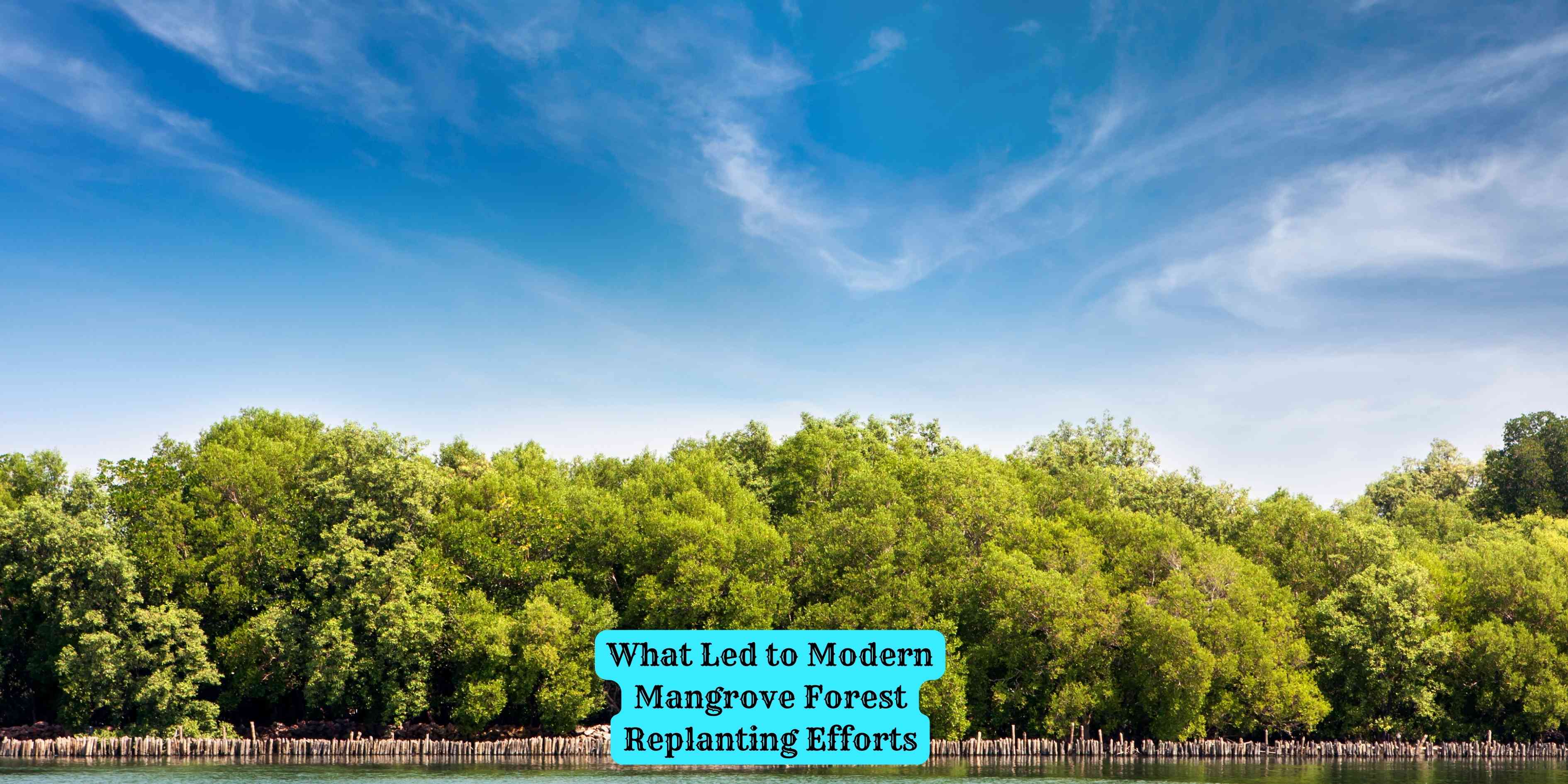
The Short Answer
Mangrove forests — coastal wetland ecosystems found in tropical and subtropical regions, characterized by salt-tolerant trees with distinctive root systems that grow at the interface of land and sea — were historically misunderstood and systematically destroyed. For most of the 20th century, they were treated as wasteland: useless, disease-ridden, obstacles to development. Decades of clearing for aquaculture, agriculture, urban development, and timber produced a global ecological crisis. The accumulation of scientific evidence documenting what had been lost — and the services mangroves provide to coastal communities, biodiversity, and the global climate — drove the development of modern replanting and restoration efforts.
The History of Mangrove Destruction
Mangrove forests once covered an estimated 75% of the world’s tropical coastlines. By the early 21st century, an estimated 35-50% of the world’s mangroves had been lost since the mid-20th century — one of the fastest rates of habitat destruction of any ecosystem type globally.
The drivers of loss were multiple. Shrimp and fish aquaculture expanded dramatically across Southeast Asia and Latin America from the 1960s onward, and mangrove forests were cleared to create aquaculture ponds because they occupied coastal land and because their removal seemed to offer no significant loss. Rice farming in coastal areas cleared mangroves for paddy fields. Urban development in coastal tropical cities expanded into mangrove zones that had not previously been built upon. Charcoal production and timber harvesting reduced mangrove forests in parts of Africa and Asia. Salt production facilities replaced mangroves in coastal areas.
The losses were particularly acute in Southeast Asia — Indonesia, the Philippines, Myanmar, and Thailand — which historically held some of the world’s largest mangrove areas. Indonesia alone lost more than a million hectares of mangroves between 1980 and 2005.
Why Mangrove Loss Became a Crisis
For most of the 20th century, the losses were not recognized as a significant ecological problem because the ecological and economic value of mangroves had not been clearly established. The shift came as scientific understanding of mangrove ecosystem services accumulated.
The 2004 Indian Ocean tsunami was a pivotal event. Research published in the years following the disaster found that coastal communities protected by intact mangrove forests experienced significantly lower mortality and infrastructure damage than communities in areas where mangroves had been cleared. The physical structure of mangrove root systems and the forest itself was found to attenuate wave energy, reduce storm surge, and buffer coastlines against extreme events. Communities in Thailand, India, Sri Lanka, and Indonesia where mangrove clearing had been extensive suffered greater losses than those where forest remained.
This evidence transformed the political and practical understanding of mangroves from economic liabilities to coastal protection infrastructure. The economic value of the protection services mangroves provide — which had been replaced by cleared land worth relatively little — suddenly became visible in the form of losses that prevention would have avoided.
The Scientific Case for Mangroves
Concurrent with the tsunami evidence, scientific research began documenting the full range of mangrove ecosystem services:
Carbon storage: Mangroves store carbon at among the highest rates per hectare of any ecosystem on earth — in their biomass but also, crucially, in the anaerobic soils beneath them, which accumulate carbon in the absence of oxygen. When mangroves are cleared, this stored carbon is released. Mangrove restoration emerged as a significant tool in climate change mitigation.
Fisheries support: Mangrove root systems provide nursery habitat for a significant proportion of commercially important fish and shellfish species in tropical and subtropical waters. The same shrimp farms that replaced mangroves were found to be reducing the productivity of adjacent fisheries by eliminating nursery habitat — a striking economic irony.
Biodiversity: Mangroves support high biodiversity including migratory birds, reptiles, mammals, and thousands of invertebrate and plant species that depend on the ecosystem.
The Growth of Global Replanting Initiatives
The combination of documented loss rates, demonstrated ecosystem value, and the visibility provided by the 2004 tsunami created conditions for significant investment in mangrove restoration. National governments across mangrove-rich countries developed restoration programs; international conservation organizations established funding mechanisms; and the inclusion of mangrove restoration in climate financing frameworks — as a form of “blue carbon” sequestration — provided new economic rationale for replanting.
Countries including India, Bangladesh, Sri Lanka, the Philippines, and Indonesia launched significant replanting programs. The Mangroves for the Future program, supported by the International Union for Conservation of Nature, coordinated restoration across 25 countries in Asia and Africa. International climate agreements began including mangrove restoration as a recognized pathway to carbon credit generation.
What Makes Modern Replanting Efforts Different
Early mangrove replanting efforts, from the 1970s onward, had often failed — sometimes spectacularly. Monoculture plantings of single species at unsuitable sites, without attention to tidal hydrology or sediment conditions, produced high mortality rates and forests that looked successful superficially but functioned poorly as ecosystems. Modern restoration science is more rigorous: it emphasizes site assessment for hydrological suitability, selection of native species appropriate to local conditions, community involvement in planting and long-term management, and monitoring of ecological function rather than just survival rates. The recognition that mangrove restoration is most successful when it allows natural regeneration where site conditions are suitable — and that active planting should be reserved for sites where natural recovery is not occurring — represents a significant evolution from the planting-first approach that characterized earlier efforts. The modern science of mangrove restoration is, in short, more ecologically informed and more honestly evaluated than what preceded it.