

20 Things You Should Never Say to Your Child
Words said in frustration or without thinking can lodge in a child's understanding of themselves for decades. These 20 phrases are worth avoiding — along with what to say instead.
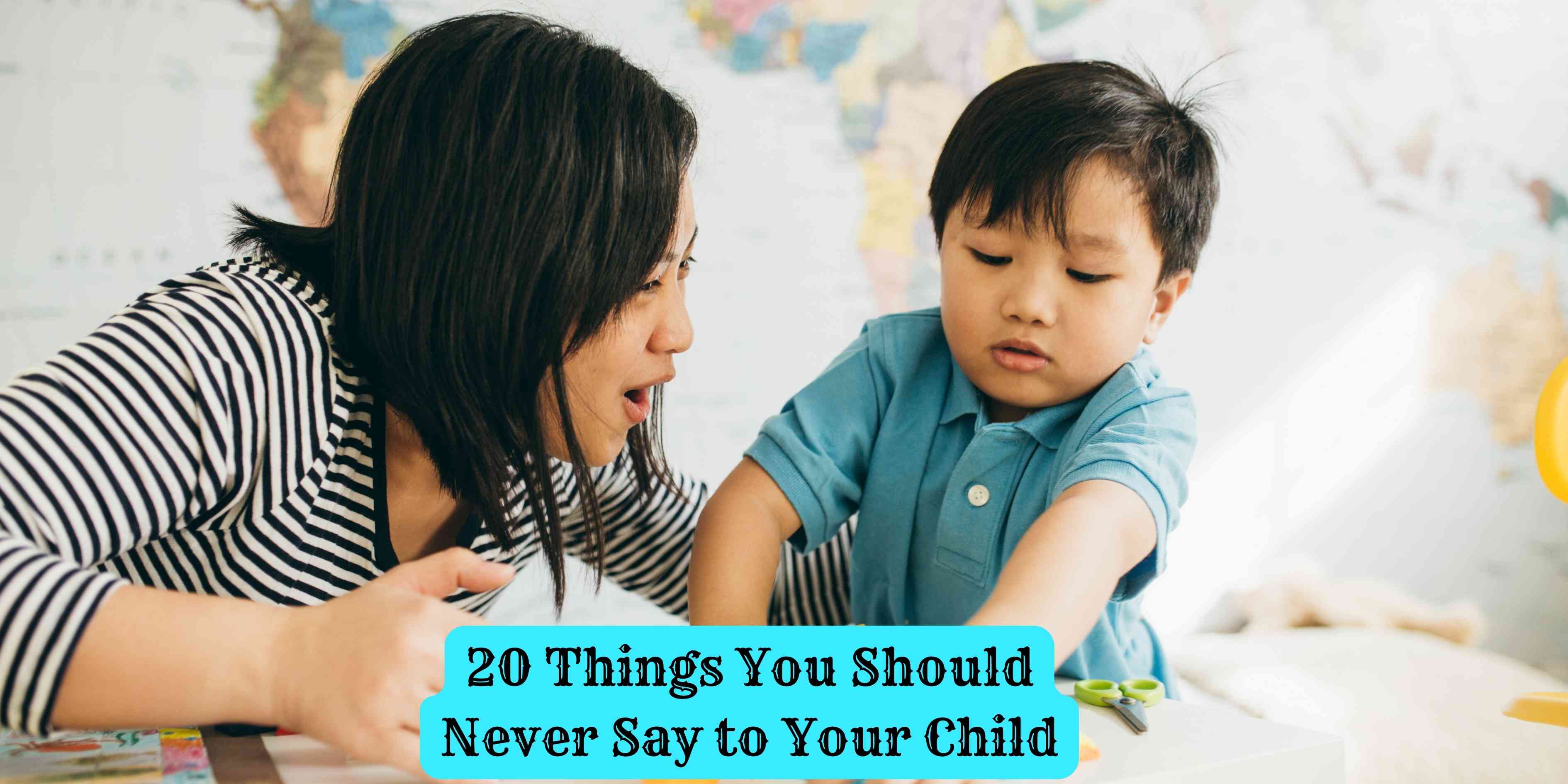
Children are forming their understanding of who they are, what they are worth, and how the world works from the earliest years of life — and parents are the primary architects of that formation. Words said in frustration, impatience, or without thinking can lodge in a child’s self-concept and remain there decades after the moment that produced them has been forgotten by the adult who said them.
These 20 phrases are worth knowing and worth avoiding — not because parents must be perfect, but because awareness enables the small choices that compound into a child’s sense of themselves over time.
Statements That Attack Identity Rather Than Behavior
The most psychologically damaging phrases conflate the child’s behavior with their identity — telling them not what they did but what they are.
1. “You’re so stupid.” No version of this is acceptable. Said in frustration after a repeated mistake or a bad decision, it brands the child’s intelligence — the very tool they will need to navigate every difficulty of their entire life — as inadequate. Children who are told they are stupid often internalize this assessment and stop trying in precisely the domains where effort would most help them.
2. “You’re lazy.” As with intelligence, labeling a child “lazy” rather than addressing specific behaviors (“you didn’t do your homework again”) produces a fixed, negative self-identity rather than a correctable behavior. Children who identify as lazy use that identity to explain future failures rather than confronting them.
3. “You’re just like your father/mother” (negatively). Using a child as a vessel for parental conflict or contempt for the other parent damages the child’s sense of identity at the root. The child is made of both parents. Telling them they resemble the one you want them not to resemble — in an accusatory way — is not discipline; it is harm.
4. “You always mess everything up.” The words “always” and “never” in accusatory statements teach children to see themselves in terms of permanent, fixed failures rather than moments of falling short that can be improved.
5. “Why can’t you be more like your sibling?” Comparison between siblings produces resentment in both directions and communicates to the child that who they are is inadequate relative to another person. Each child needs to be developed as the individual they are.
Phrases That Invalidate Emotional Experience
6. “Stop crying or I’ll give you something to cry about.” This phrase — common in certain parenting traditions — teaches children that expressing distress is dangerous, that their emotional experience is an imposition, and that adults are threats rather than sources of comfort. The suppression of emotional expression it produces is not strength; it is a learned inability to process difficulty.
7. “You’re being so dramatic.” Children have genuine emotional experiences with limited context and limited regulation capacity. Telling them their response is excessive communicates that their internal experience is wrong, rather than helping them develop the capacity to regulate it.
8. “Big boys/girls don’t cry.” Gender-specific messaging about the unacceptability of emotional expression teaches children to disconnect from and suppress their internal states. Boys taught not to cry often become adults who cannot access or express grief, fear, or vulnerability — at significant cost to their relationships and wellbeing.
9. “It’s not a big deal.” To the child, it is a big deal. Their emotional experiences are calibrated to their developmental stage and their understanding of the world. Dismissing what feels big to them communicates that their internal world is not worth your attention.
Threat-Based Phrases
10. “I’ll leave you here if you don’t behave.” Threatening abandonment — even as a bluff to produce compliance — activates the child’s deepest terror (loss of their caregiver) and produces short-term compliance at the cost of long-term attachment security. Children who are threatened with abandonment experience anxiety that persists into adult attachment relationships.
11. “Nobody is going to like you if you act like this.” Social rejection is one of the most powerful fears in children’s lives. Using it as a threat weaponizes that fear and communicates that your love is also conditional on behavior — a message no child should receive.
12. “Wait until your father/mother gets home.” Deferring consequences to an absent parent positions that parent as the threat rather than the partner, undermines both parents’ authority, and extends a child’s anxiety across the hours they wait. Address behavior when it happens.
Phrases That Shame Rather Than Guide
13. “I’m so disappointed in you.” Disappointment, communicated in these words, reaches below the behavior to the child’s worth as a person in their parent’s eyes. While parents do experience disappointment, the communication of it as a shaming statement is different from the communication of specific concern about a specific behavior. “I’m worried about this choice you made” focuses on the behavior; “I’m so disappointed in you” focuses on the child.
14. “You should be ashamed of yourself.” Shame is the feeling that there is something wrong with you as a person — not with what you did, but with what you are. Research by Brené Brown and others consistently finds that shame is associated with more harmful outcomes than guilt (the feeling that you did something wrong), which is actually associated with repair and change. Inducing shame is not effective discipline.
15. “How could you do this to me?” Making the child responsible for the parent’s emotional state — positioning their behavior as something done to the parent — burdens children with emotional caretaking that is not appropriate to their developmental stage and produces guilt disproportionate to most childhood offenses.
Phrases That Undermine Capability
16. “You’ll never be able to do that.” Fixed, negative assessments of a child’s capability produce the outcome they describe. Children who are told they cannot do something often do not try. Self-fulfilling prophecies are particularly potent in childhood when the assessors are the parents.
17. “Let me just do it — you’re taking too long.” Removing a child’s opportunity to complete something independently because they are slow or making a mess communicates that their effort is an obstacle rather than a development. Children who are consistently done for rather than supported in doing develop learned helplessness in domains where they should be building competence.
18. “I wish you were more like when you were little.” A child who hears this understands that the version of them the parent prefers is the version that existed before they became themselves. It communicates that development and individuation — the becoming of a person — is a disappointment.
What Should Never Be Said
19. “I love your sister/brother more.” Even in apparent jest. Even once. This statement lodges immediately and deeply.
20. “I never wanted children” or “I wish you’d never been born.” These phrases, said in the worst moments of parental exhaustion or anger, are the words children carry for life. No amount of correction or apology fully removes them. They represent the ultimate betrayal of the fundamental parental relationship. They should never be said.
A final note: no parent communicates perfectly. The goal is not the elimination of all mishandled moments — it is the cultivation of a relationship built on enough repair, presence, and genuine love that the inevitable missteps do not define the child’s self-understanding.