

Four Amendments to the Constitution About Who Can Vote – the 15th Amendment
Four constitutional amendments expanded the right to vote in the United States. The Fifteenth Amendment, ratified in 1870, prohibited the denial of voting rights on the basis of race — and its history is more complicated than its text suggests.
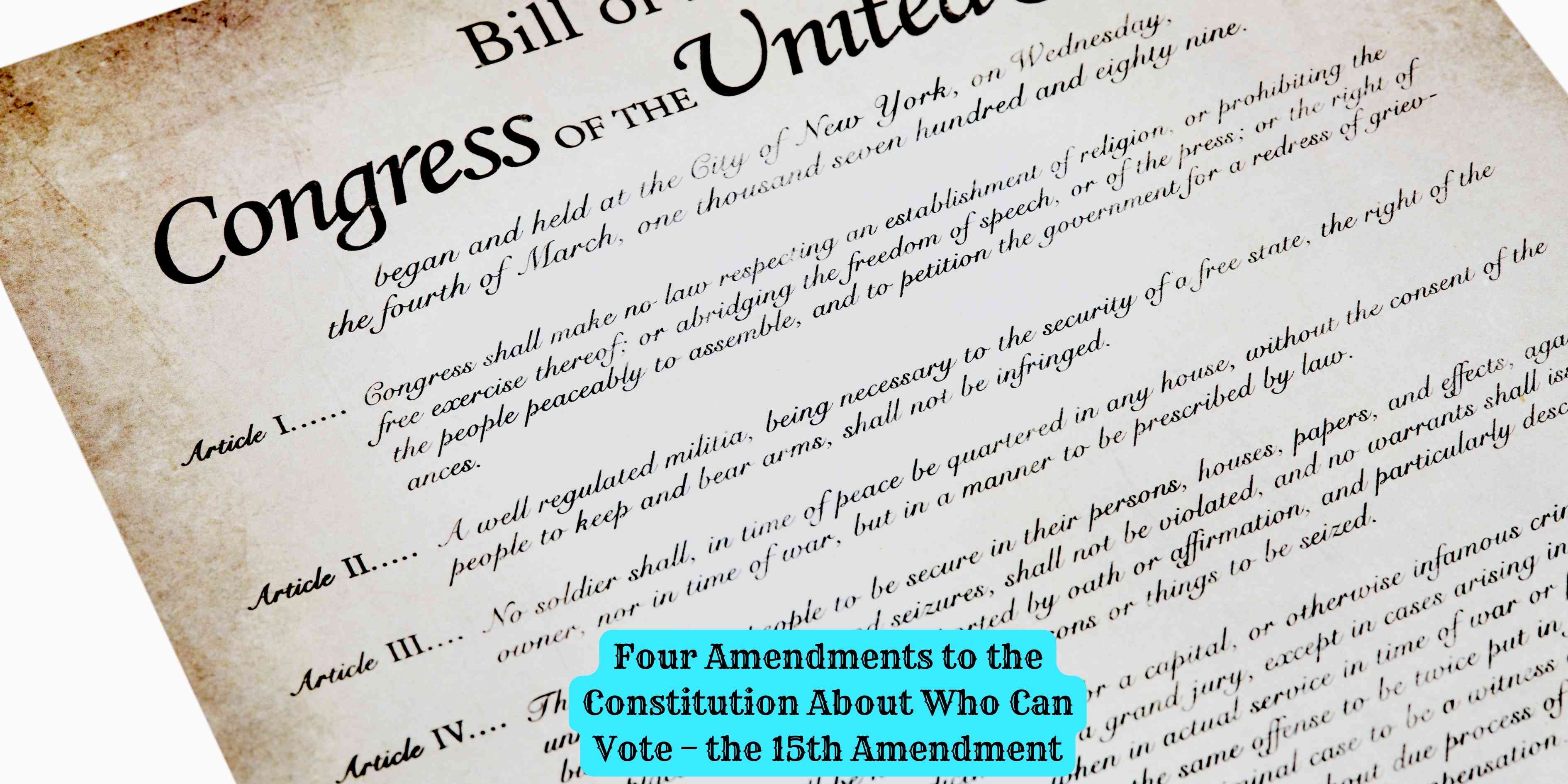
Four amendments to the United States Constitution directly address the question of who may vote: the Fifteenth (1870, prohibiting denial of suffrage based on race), the Nineteenth (1920, prohibiting denial based on sex), the Twenty-Fourth (1964, prohibiting poll taxes in federal elections), and the Twenty-Sixth (1971, establishing voting rights for citizens aged 18 and older). This article describes the Fifteenth Amendment — its historical context, its text, the century-long gap between its ratification and its practical enforcement, and its lasting constitutional significance.
The Four Voting Rights Amendments
Before examining the Fifteenth Amendment specifically, it is useful to understand how the four amendments fit together:
The Fifteenth Amendment (ratified 1870) addressed racial exclusion from voting. The Nineteenth Amendment (ratified 1920) addressed sex exclusion. The Twenty-Fourth Amendment (ratified 1964) prohibited poll taxes in federal elections — devices used primarily to exclude poor Black voters in Southern states. The Twenty-Sixth Amendment (ratified 1971) lowered the voting age from 21 to 18, partly in response to the argument that if 18-year-olds could be drafted to fight in Vietnam, they should be able to vote.
Each amendment addressed a specific mechanism of exclusion that the previous text left uncorrected.
The Fifteenth Amendment: Origins and Context
The Fifteenth Amendment was ratified on February 3, 1870, five years after the end of the Civil War and during the period of Reconstruction — the effort to reintegrate Southern states into the Union and define the legal status of formerly enslaved people.
The Fourteenth Amendment (1868) had established birthright citizenship and equal protection under the law for all citizens, including formerly enslaved Black Americans. But it had not directly addressed voting rights. Southern states and northern states alike maintained restrictions that effectively excluded Black men from voting — residency requirements, literacy tests, and other devices. Congress and the Republican majority that controlled it during Reconstruction pushed the Fifteenth Amendment to close this specific gap.
The amendment was controversial at ratification. Several states initially refused to ratify it. Women’s suffrage advocates were divided — the amendment extended voting rights to Black men but not to women of any race, creating a painful conflict within the coalition that had worked for multiple forms of equality. The final ratification was a political accomplishment achieved in the specific window of Reconstruction’s power.
What the Fifteenth Amendment Says
The text of the Fifteenth Amendment is brief:
Section 1: “The right of citizens of the United States to vote shall not be denied or abridged by the United States or by any State on account of race, color, or previous condition of servitude.”
Section 2: “The Congress shall have power to enforce this article by appropriate legislation.”
The amendment does not create an affirmative right to vote — it prohibits a specific basis for denial. States retained authority to determine voter qualifications, so long as race, color, or prior servitude was not the explicit reason for exclusion.
The Enforcement Gap (1870–1965)
Almost immediately after ratification, the practical enforcement of the Fifteenth Amendment began to collapse. As Reconstruction ended and federal troops withdrew from Southern states in the 1870s, states developed a sophisticated system of facially race-neutral restrictions that systematically disenfranchised Black voters: literacy tests administered selectively, poll taxes, grandfather clauses (allowing men to vote only if their grandfathers had voted — excluding descendants of enslaved people), white primaries (restricting primary elections to white voters), and physical intimidation backed by law enforcement and vigilante violence.
For most of the period between the 1870s and the 1960s, the Fifteenth Amendment’s guarantee was largely a dead letter for Black voters in the South. The Supreme Court’s narrow interpretation of the amendment and Congress’s failure to enforce it allowed the disenfranchisement system to persist for nearly a century.
The Fifteenth Amendment’s Lasting Significance
The Fifteenth Amendment was finally given practical force by the Voting Rights Act of 1965, which specifically prohibited the voting restrictions — literacy tests, preclearance requirements for states with histories of discrimination — that had been used to nullify the amendment’s guarantee for ninety-five years. The Act transformed Black political participation almost immediately: in Mississippi, Black voter registration went from 6.7% in 1964 to 59.8% in 1967. The Fifteenth Amendment’s significance is therefore twofold: as a constitutional principle that formally prohibited racial exclusion from voting, and as an object lesson in the gap between constitutional text and constitutional reality — showing that formal rights without enforcement mechanisms and political will to use them are hollow. The amendment remains the constitutional anchor for federal voting rights litigation and legislation today.