

The Effect That World War I Had on Art, and How It Was Forever Changed After That Conflict
World War I killed millions and destroyed the 19th century's faith in progress. The art that followed — Dada, Expressionism, Surrealism — was shaped by the war's horror in ways that changed everything.
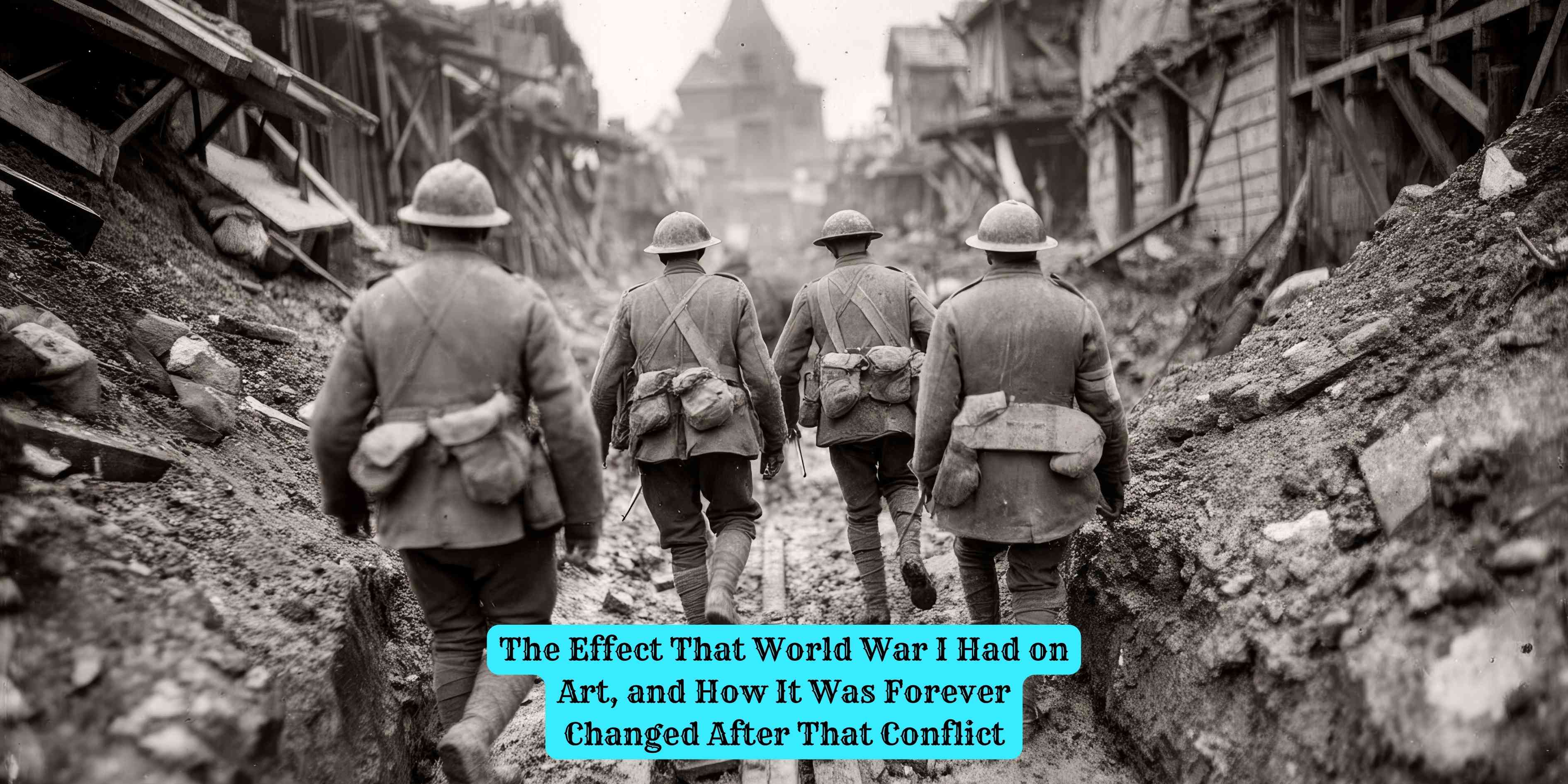
World War I (1914-1918) was the most technologically destructive conflict in human history to that point — machine guns, poison gas, aerial bombardment, artillery barrages that could kill thousands in hours. For artists, intellectuals, and ordinary people who had grown up in the relative prosperity and optimism of the late 19th and early 20th centuries, the war represented a catastrophic failure of civilization itself: the same reason, science, and industrial organization that had promised human progress had been turned toward mass slaughter. The art that followed was shaped by this experience — in some cases directly, in others indirectly — and the changes were permanent.
Art Before the War: Late 19th Century Optimism
To understand what the war changed, it helps to understand what it changed from. The dominant mood of European culture in the decades before 1914 — sometimes called the Belle Époque — included a pervasive sense of progress: scientific advancement, economic growth, expanding literacy, and a belief that civilization was on an upward trajectory. This optimism is reflected in Impressionism’s celebration of modern leisure, in Art Nouveau’s joyful organic ornament, and in the ambitious public art of late 19th-century Europe.
Even the artistic avant-garde of the prewar period — the Fauvists, the early Cubists, the German Expressionists — expressed their radicalism in terms of energy, vitality, and formal innovation rather than horror or despair. The world felt like it was going somewhere.
The Direct Impact of the War on Artists
Many of the major artists of the early 20th century served in or were directly affected by the war. Some were killed: the German Expressionist painters Franz Marc and August Macke both died in combat in 1916. Wilfred Owen, the British poet whose work provides the most vivid literary account of trench warfare, was killed one week before the armistice. Thousands of painters, sculptors, and writers who survived returned fundamentally changed by what they had witnessed.
The visual art of the war itself — produced by official war artists in Britain, France, Germany, and elsewhere — documented the unprecedented scale of destruction: vast blasted landscapes, mutilated bodies, the industrial machinery of killing. Artists like Paul Nash (Britain) and Otto Dix (Germany) produced work that confronted the reality of modern warfare with unflinching directness. Dix’s Der Krieg (The War, 1929-1932), a cycle of 50 prints, is among the most disturbing anti-war art ever created.
Dada: Art as Protest Against Reason
The Dada movement, which emerged in Zurich in 1916 among artists who had fled to neutral Switzerland, was the most direct artistic response to the war’s irrationality. Dada’s founding insight was that a civilization that could produce the systematic slaughter of the Western Front had forfeited its claim to reason — and that art which continued to operate within the conventions of that civilization was complicit in its failure.
Dada embraced deliberate nonsense, randomness, absurdity, and the destruction of artistic conventions. Marcel Duchamp’s “readymades” — ordinary manufactured objects (a urinal, a bicycle wheel) declared to be art — challenged the very definition of art and artistic skill. The Dada cabaret in Zurich staged performances designed to be incoherent and provocative rather than aesthetically pleasing. The movement was anti-art in the sense of being anti-the-art-that-had-failed-to-prevent-the-catastrophe.
German Expressionism and Psychological Aftermath
German Expressionism — already developing before the war in the work of Kirchner, Beckmann, and others — deepened significantly in response to the war’s psychological trauma. Where prewar Expressionism had been energetic and emotionally intense, postwar German Expressionism became darker, more distorted, and more explicitly focused on alienation, trauma, and social dysfunction.
Max Beckmann, who served as a medical orderly and suffered a breakdown, returned to painting with a completely transformed vision — urban scenes filled with claustrophobic space, distorted figures, and a sense of existential dread. The cabaret scenes, prostitutes, and street life of Weimar Germany in his work feel saturated with the knowledge of what had just happened and with foreboding about what was coming.
How Art Was Forever Changed
The permanent changes that World War I made to Western art are difficult to overstate. Before the war, even the most radical avant-garde movements maintained some relationship to beauty, celebration, or positive vision. After the war, irony, despair, absurdism, and formal disintegration became permanent residents in the house of modern art. Surrealism — which emerged in the 1920s directly from Dada — explored the unconscious, dream logic, and the disturbing content beneath the surface of rational civilization. The war demonstrated that the “progress” of modern civilization was not the straightforward upward trajectory that optimism had assumed. Art absorbed this lesson and never fully recovered the innocent confidence that preceded it — which is another way of saying that art became more honest about the full range of what human civilization is capable of.