

How the Meniscus Is Used to Read Volume Measurements on a Graduated Cylinder
Reading a graduated cylinder correctly requires knowing which part of the curved liquid surface to measure. Here's what the meniscus is, why it forms, and how to get an accurate reading.
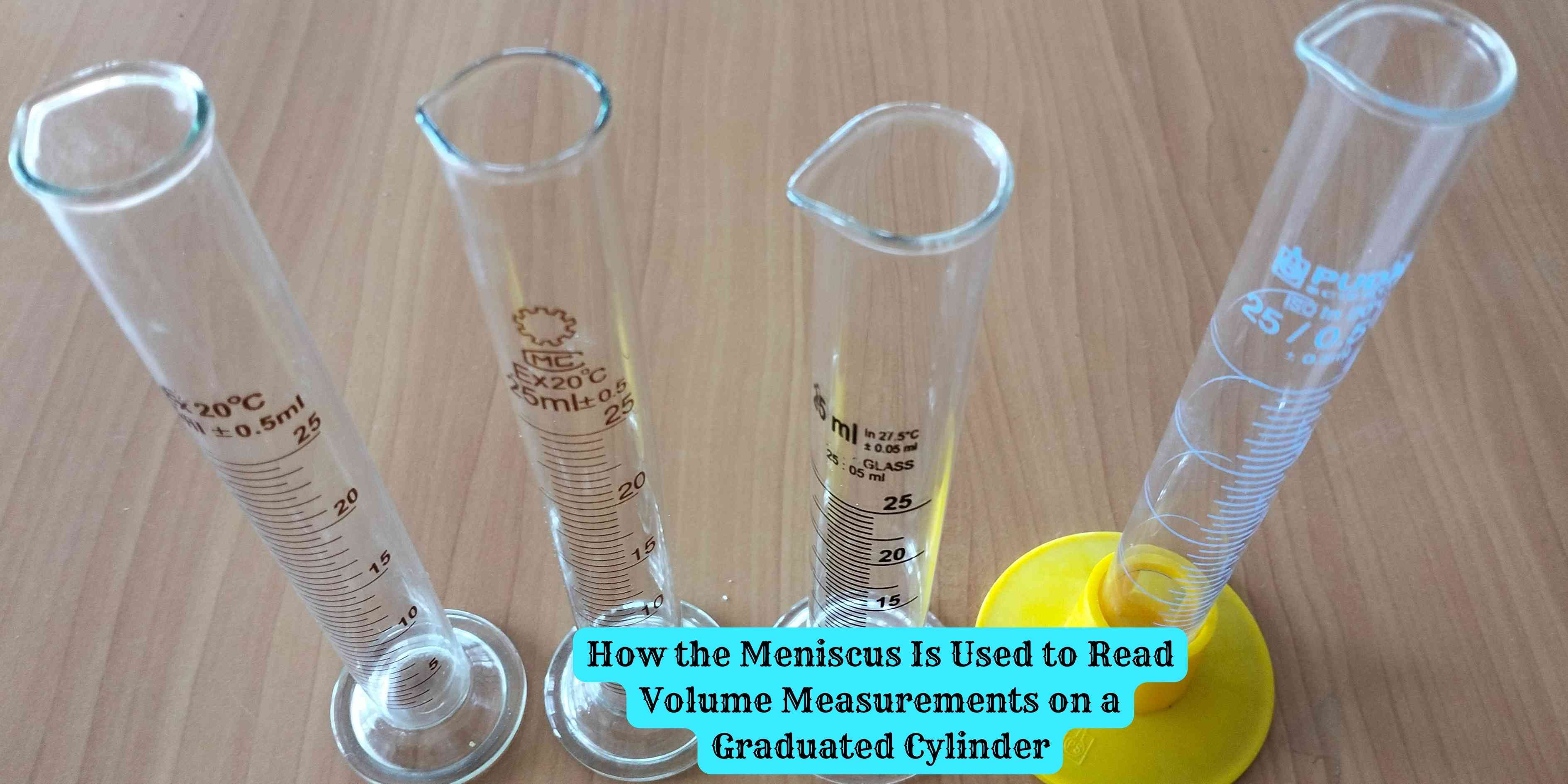
The Short Answer
When liquid is placed in a graduated cylinder, the surface of the liquid is not flat — it curves into a concave shape called the meniscus (for most liquids, including water) or a convex shape (for mercury). Reading volume accurately requires reading the correct part of this curved surface: for most laboratory liquids, you read the bottom of the concave meniscus, not the top of the curve. Incorrect reading of the meniscus is one of the most common sources of measurement error in basic laboratory work.
What the Meniscus Is
The meniscus is the curved surface that forms at the top of a liquid in a narrow container. The word comes from the Greek word for “crescent.” Its shape is produced by the interaction between two forces: adhesion (the attraction between the liquid molecules and the glass molecules of the container wall) and cohesion (the attraction of liquid molecules to each other).
In water and most aqueous solutions used in laboratory settings, adhesion to glass is stronger than cohesion — water “wants” to stick to the glass more than it wants to stick to itself. This causes the edges of the water surface to climb slightly up the glass wall, creating the characteristic downward curve (concave meniscus) with the outer edges higher than the center.
In mercury, the opposite is true: cohesion is stronger than adhesion to glass, and the surface curves upward in the center, producing a convex meniscus.
Why Reading Position Matters
Because the meniscus is curved, where you take the measurement determines the value you record. If you read the top of a concave meniscus rather than the bottom, you will systematically record a higher volume than is actually present in the cylinder. The error may be small in a wide container but is significant in a narrow graduated cylinder where a small height difference corresponds to a larger volume difference.
The standard practice in laboratory science is to read a concave meniscus at the bottom of the curve — at the lowest point of the liquid surface. This is the actual, accurate volume of liquid in the cylinder.
How to Read the Meniscus Correctly
To read the meniscus accurately:
1. Position your eye at the level of the liquid surface. Reading from above or below introduces parallax error — the apparent position of the meniscus shifts depending on viewing angle. Your line of sight must be horizontal and level with the bottom of the meniscus.
2. Read the bottom of the concave meniscus for water and most aqueous solutions. Identify the lowest point of the curved surface and read the graduation mark at that level.
3. Read the top of a convex meniscus for mercury. The highest point is the accurate reading.
4. Use the nearest marked graduation. Read to the precision the instrument allows — typically to the nearest 0.1 mL for a standard laboratory graduated cylinder, estimating one digit beyond the smallest graduation.
5. Record units. Volume in a graduated cylinder is measured in milliliters (mL) or cubic centimeters (cm³), which are equivalent.
Common Errors in Meniscus Reading
Parallax error is the most frequent mistake: reading from an angle rather than at eye level causes the apparent position of the meniscus bottom to shift. Always position your eye level with the measurement.
Reading the top rather than the bottom of a concave meniscus produces a consistently high reading — the systematic overestimate compounds across multiple measurements.
Failing to allow the liquid to settle — pouring liquid rapidly and reading immediately may produce a disturbed surface. Allow the liquid to settle fully before reading.
Not accounting for the type of liquid — water is concave; mercury is convex. Applying the wrong reading rule to the wrong liquid produces consistent errors.
Practical Tips for Accurate Measurements
In practical laboratory work, minimizing meniscus reading error requires both equipment handling and reading technique. A steady, level surface prevents the liquid from tilting, which would skew the apparent meniscus position. Holding the graduated cylinder by the barrel (not the base) at eye level, or placing it on the bench and bending down to eye level, is more reliable than trying to lift it to your face. For very precise volumetric measurements, volumetric flasks and pipettes are preferred over graduated cylinders because they are calibrated to a single volume marked by a flat-bottomed meniscus line, removing the need to read a curved surface at all. Graduated cylinders remain useful for approximate volume measurement when high precision is not required — but even approximate measurements are more accurate when the meniscus is read correctly.