

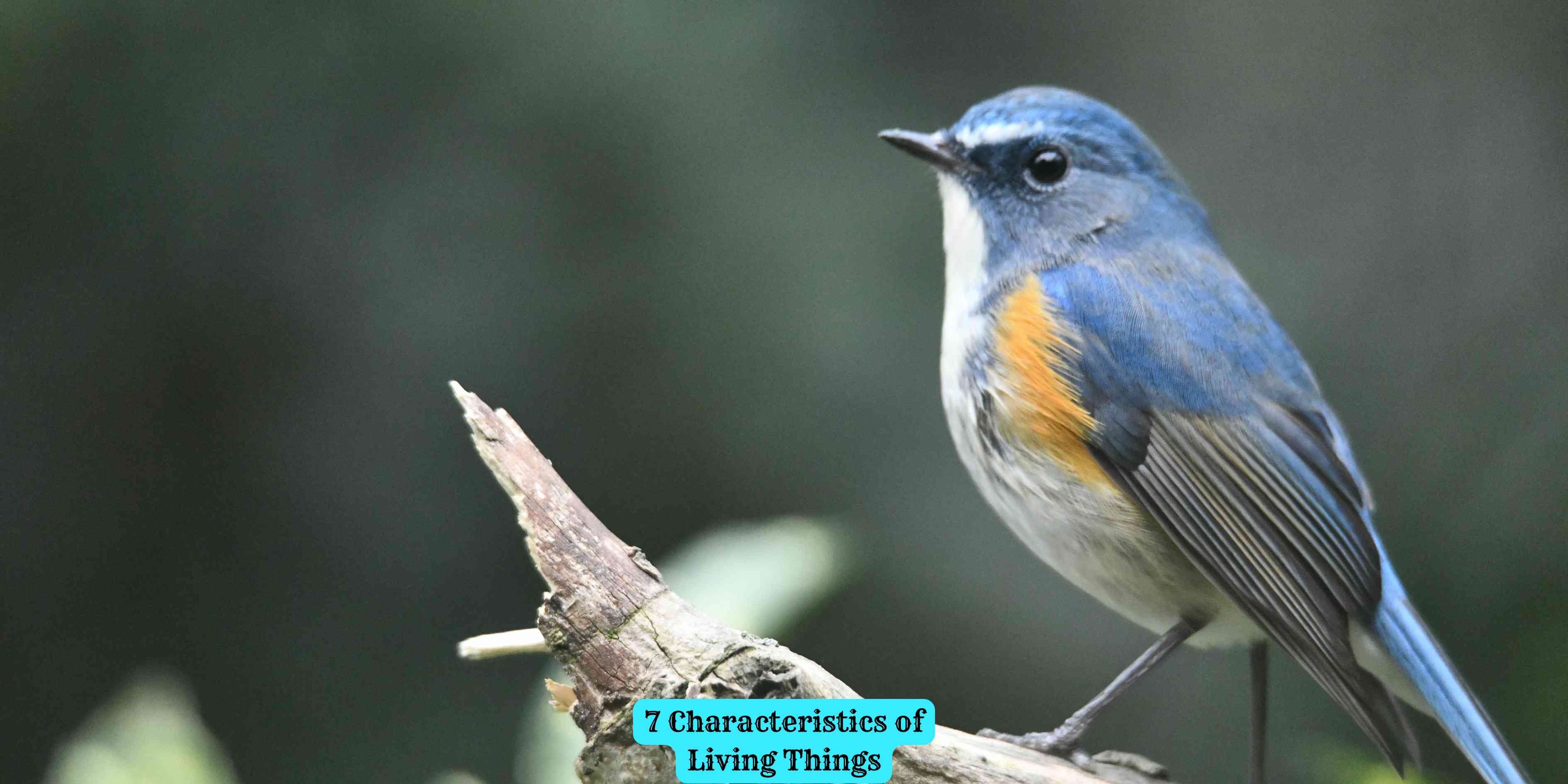
7 Characteristics of Living Things
Living things share key characteristics: cellular structure, organization, metabolism, homeostasis, growth, response to stimuli, and reproduction.
Biology is the study of life, but deciding what counts as “living” requires more than simply looking at something and guessing. A tree, dog, mushroom, bacterium, and human are clearly alive. A rock, pencil, fire, and cloud are not alive, even though some may move, grow, or change in some way.
Scientists identify living things by looking for shared characteristics. No single feature explains all life perfectly, but together these traits help separate living organisms from nonliving things.
Living things are organisms that are made of cells, use energy, maintain internal balance, grow, respond to their environment, and pass life processes to the next generation.
The seven characteristics of living things are:
- Made of cells.
- Organized structure.
- Metabolism and energy use.
- Homeostasis.
- Growth and development.
- Response to stimuli.
- Reproduction.
These traits work together to define life in biology.
1. Living Things Are Made of Cells
All living things are made of one or more cells. Cells are the basic units of life. Some organisms, such as bacteria and many protists, are unicellular, meaning they consist of one cell. Others, such as plants, animals, and humans, are multicellular.
Cells contain structures that help organisms carry out life processes. For example, cells can take in materials, use energy, remove waste, and reproduce.
This is one major reason a rock is not alive. It may contain minerals, but it is not made of cells.
2. Living Things Have Organization
Living things are organized at different levels. In a multicellular organism, cells form tissues, tissues form organs, organs form organ systems, and organ systems work together as an organism.
Even single-celled organisms are organized. Their internal structures work together to support survival.
Organization matters because life is not random movement. Living systems have coordinated parts that perform functions.
3. Living Things Use Energy
All living things need energy. Plants capture light energy through photosynthesis. Animals get energy by eating food. Fungi absorb nutrients from their surroundings. Bacteria may use many different energy sources depending on the species.
The chemical processes that use and transform energy are called metabolism. Metabolism includes building molecules, breaking down food, repairing cells, moving materials, and supporting growth.
Without energy, life processes stop.
4. Living Things Maintain Homeostasis
Homeostasis means maintaining a stable internal environment. Living things must regulate internal conditions even when the outside environment changes.
Examples include:
- Humans regulating body temperature.
- Plants controlling water loss through stomata.
- Cells balancing water and salts.
- Animals maintaining blood sugar levels.
Homeostasis does not mean nothing changes. It means organisms adjust to keep internal conditions within a survivable range.
5. Living Things Grow and Develop
Living things grow. A seed becomes a plant, a baby becomes an adult, and a single-celled organism may increase in size before dividing.
Development is the process of changing form or function over time. In animals, development may include stages such as embryo, infant, juvenile, and adult. In plants, it may include germination, flowering, and fruit production.
Growth in living things is controlled by genetic instructions and life processes, not simply by material piling up.
6. Living Things Respond to Stimuli
Living things respond to changes in their environment. A stimulus is anything that causes a response.
Examples include:
- Plants bending toward light.
- Humans pulling away from heat.
- Bacteria moving toward nutrients.
- Animals responding to sound or danger.
Response helps organisms survive. If living things could not respond, they would struggle to find food, avoid harm, reproduce, or adjust to changing conditions.
7. Living Things Reproduce
Living things can reproduce, meaning they produce new individuals of their kind. Reproduction can be sexual, involving two parents, or asexual, involving one parent.
Examples include:
- Bacteria dividing by binary fission.
- Plants producing seeds.
- Fungi releasing spores.
- Animals producing offspring.
Not every individual organism reproduces. For example, a worker bee may not reproduce, and some humans do not have children. But reproduction is still a characteristic of life at the species level.
Why These Characteristics Matter
These seven characteristics help students understand life scientifically. They also show that living things are complex systems, not just objects that move or grow.
For example, fire grows and uses fuel, but it is not made of cells, does not maintain homeostasis, and does not reproduce biologically. A virus has genetic material and can replicate inside host cells, but many scientists do not classify viruses as fully living because they cannot carry out life processes independently.
Final Thoughts
The seven characteristics of living things are cellular structure, organization, energy use, homeostasis, growth and development, response to stimuli, and reproduction.
Together, these traits explain why organisms are alive and help biology students compare living and nonliving things clearly.