

Understanding Opportunity Cost Through Trade-Offs
Opportunity cost is what you give up when you choose one option over another. Understanding trade-offs helps students make smarter decisions with time, money, and resources.
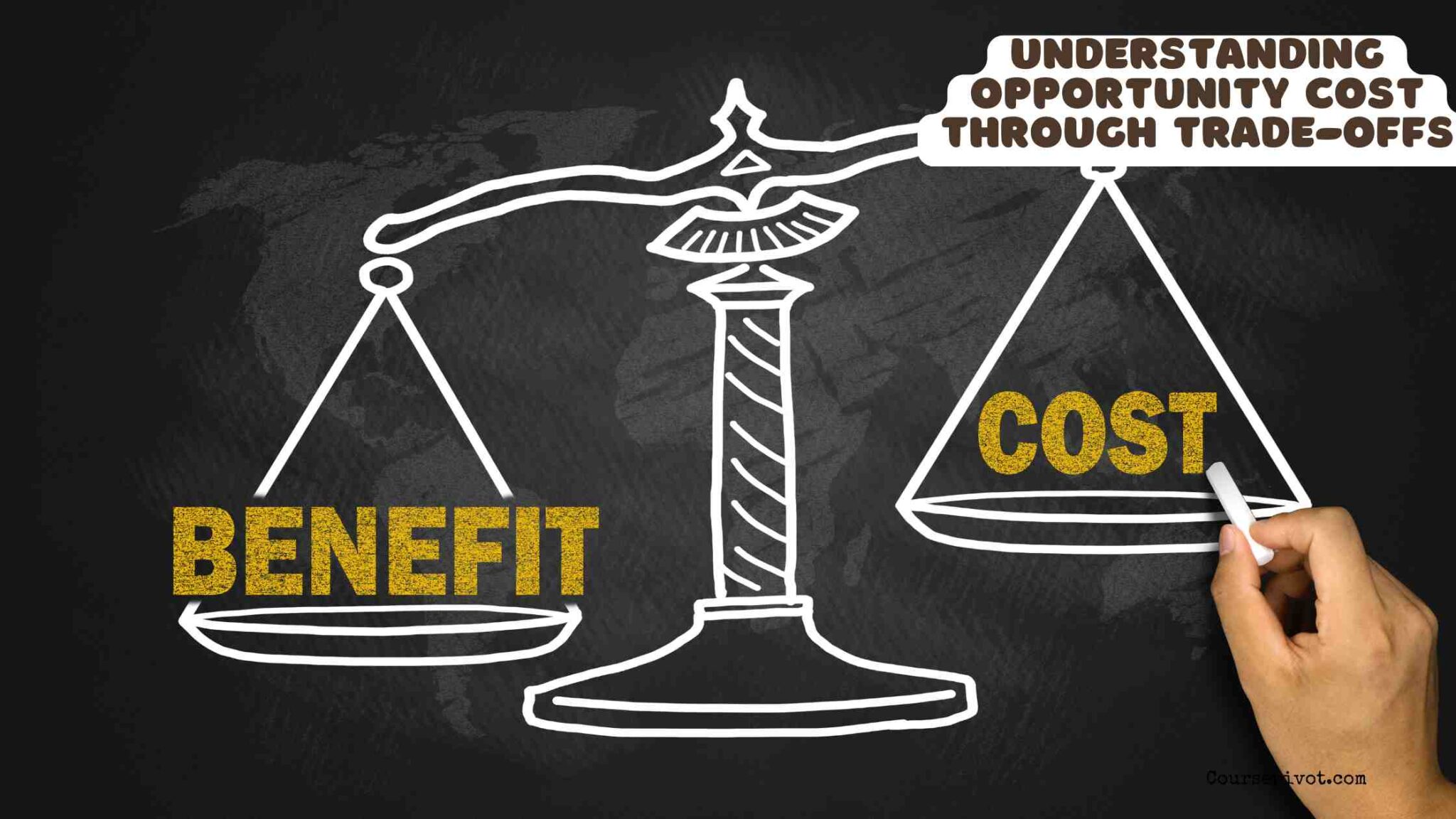
Opportunity cost is one of the most useful ideas in economics because it explains a truth everyone faces: choosing one thing usually means giving up something else. Every student, family, business, and government has limited resources. Time, money, energy, attention, land, labor, and materials cannot be used for everything at once.
Opportunity cost is the value of the best alternative you give up when you make a choice.
Trade-offs are the choices between alternatives. Opportunity cost is the cost of the next-best option you did not choose. Once you understand that difference, many everyday decisions become easier to analyze.
1. Opportunity Cost Starts with Scarcity
Opportunity cost exists because resources are scarce. Scarcity does not always mean poverty or shortage. It simply means there is not enough of something to satisfy every possible use at the same time.
A student has only so many hours after school. A family has only so much money in a monthly budget. A business has limited workers, machines, and cash. A government has limited tax revenue, land, and public attention.
Because resources are limited, every choice has a cost. If you spend two hours watching a movie, you cannot use those same two hours to study, sleep, work, exercise, or meet a friend. The movie may still be worth it, but it is not free in the economic sense. You gave up another possible use of that time.
Scarcity is the reason opportunity cost matters. Without scarcity, there would be no need to choose.
2. Trade-Offs Are the Choices You Compare
A trade-off is the act of giving up one thing to get another. When you choose between studying and gaming, saving and spending, working and resting, or buying one item instead of another, you are facing a trade-off.
Trade-offs are not automatically bad. They are part of decision-making. The goal is not to avoid trade-offs. The goal is to recognize them clearly so you can choose with awareness.
For example, if a student joins a sports team, the benefits may include exercise, friendships, discipline, and fun. The trade-off may be less time for homework, part-time work, or other activities. That does not mean joining the team is wrong. It means the student should understand what the choice requires.
A hidden trade-off can create stress later. A clear trade-off helps you plan.
3. Opportunity Cost Is the Best Option You Give Up
Opportunity cost is not every possible thing you give up. It is the best alternative you give up.
Imagine you have $20. You can buy a book, a meal, a movie ticket, or save the money. If you choose the movie, your opportunity cost is not the book plus the meal plus the savings all added together. Your opportunity cost is the next-best option you would have chosen if the movie were not available.
This distinction is important. People often exaggerate opportunity cost by counting every rejected option. Economics focuses on the most valuable alternative because that is the real choice you sacrificed.
So the key question is: “If I do this, what is the best thing I cannot do instead?“
4. Time Has Opportunity Cost
Time is one of the easiest ways to understand opportunity cost because every person gets the same 24 hours in a day, but no one can use those hours for everything.
If you spend an evening scrolling on your phone, the opportunity cost might be sleep, studying, exercise, or time with family. If you take an extra shift at work, the opportunity cost might be rest, social time, or a school assignment.
Students feel time trade-offs constantly. Preparing for a test may mean missing a party. Practicing a skill may mean less gaming. Working a part-time job may mean less time for clubs or sports.
Time management is really opportunity cost management. You are deciding which uses of time are most valuable. For student planning, three strategies you will use to ensure your academic success explains how organization, active study, and early support can reduce stressful trade-offs.
5. Money Has Opportunity Cost
Money choices are also full of opportunity costs. If you spend money on one thing, you cannot spend or save that same money for something else.
For example, buying a new phone might mean delaying a laptop, a trip, savings, textbooks, or emergency money. Eating out several times a week might mean having less money for groceries, transportation, or debt repayment.
This does not mean spending is bad. Enjoyment has value too. The point is to compare the benefit of what you buy with the value of what you give up.
Students on tight budgets feel this clearly. Buying convenience food may save time, but cost more money. Cooking may save money, but require planning. That trade-off is why practical budgeting matters. A related guide is budget-friendly meal ideas for college students.
6. School and Career Choices Involve Trade-Offs
Opportunity cost becomes more serious when choices affect education and careers. Choosing a major, job, internship, college, trade program, or graduate degree often means saying no to other paths.
For example, attending college full time may bring long-term earning potential, professional networks, and personal growth. The opportunity cost may include tuition, student debt, years of full-time work experience, or income you could have earned immediately.
Choosing a job with higher pay may mean giving up flexibility, commute time, creative satisfaction, or better work-life balance. Choosing a job with more meaning may mean accepting a lower salary or slower advancement.
The best choice depends on goals, values, skills, and circumstances. If you are weighing long-term options, 5 factors to consider when choosing a career can help connect opportunity cost to real career planning.
7. Businesses Use Opportunity Cost to Make Decisions
Businesses also face opportunity costs. A company that uses money to open a new store cannot use that same money to upgrade equipment, hire more workers, advertise, pay debt, or develop a new product.
A restaurant owner may choose between extending hours or improving food quality. A manufacturer may choose between cheaper materials and a better reputation. A technology company may choose between speed, privacy, design, security, and price.
Opportunity cost helps businesses avoid thinking only about direct expenses. The cost of a choice includes what the business loses by not choosing the next-best use of its resources.
This is why business decisions often involve trade-offs between short-term profit and long-term trust. A cheap shortcut may save money today but damage customer loyalty later.
8. Governments Face Opportunity Costs Too
Governments make opportunity cost decisions whenever they create budgets or policies. Public money spent on one priority cannot be spent on every other priority at the same time.
For example, funding a new highway may mean less money for schools, hospitals, parks, housing, tax cuts, or public transportation. Spending more on defense may mean spending less on social programs, unless taxes or borrowing increase.
These choices are difficult because public needs are real. Education matters. Healthcare matters. Infrastructure matters. Safety matters. Environmental protection matters. Opportunity cost helps citizens understand that political choices often involve competing priorities rather than simple yes-or-no answers.
This connects to larger economic comparisons too. Countries differ in how they allocate resources for health, education, infrastructure, jobs, and technology. For broader context, see exploring the differences between developed and developing countries.
9. Opportunity Cost Helps You Set Better Goals
Goals sound inspiring, but every goal requires trade-offs. If you want better grades, stronger fitness, more savings, a new skill, or a cleaner room, you must give up some time, comfort, money, or distraction.
This is why unrealistic goals often fail. People set goals without asking what they must stop doing, reduce, or delay to make the goal possible.
For example, saying “I want straight A’s, a full-time job, daily workouts, eight hours of sleep, a perfect social life, and no stress” may ignore real limits. Opportunity cost forces a better question: “Which goals matter most right now, and what am I willing to trade for them?”
That kind of thinking supports realistic planning. For more on this, read 5 likely consequences of setting unrealistic goals.
10. How to Use Opportunity Cost in Real Life
You can use opportunity cost by slowing down before important choices and asking a few practical questions.
- What are my realistic options?
- What is the best alternative if I do not choose this?
- What do I gain from this choice?
- What do I give up?
- Is the benefit worth the trade-off?
- Will this choice still make sense later?
The best decisions are not always the cheapest, fastest, or easiest. Sometimes the right choice costs more money but saves time. Sometimes it costs comfort but builds discipline. Sometimes it costs short-term fun but protects a long-term goal.
Opportunity cost does not make decisions automatic. It makes them clearer.
Final Thoughts
Understanding opportunity cost through trade-offs helps you see the real cost of choices. Opportunity cost is not just money spent. It can be time, energy, attention, learning, relationships, health, or future opportunity.
Every choice has a cost because resources are limited. When you compare trade-offs honestly, you become better at choosing what matters most. That is why opportunity cost is not only an economics term. It is a life skill.