

How Many Times Has the Insurrection Act Been Invoked?
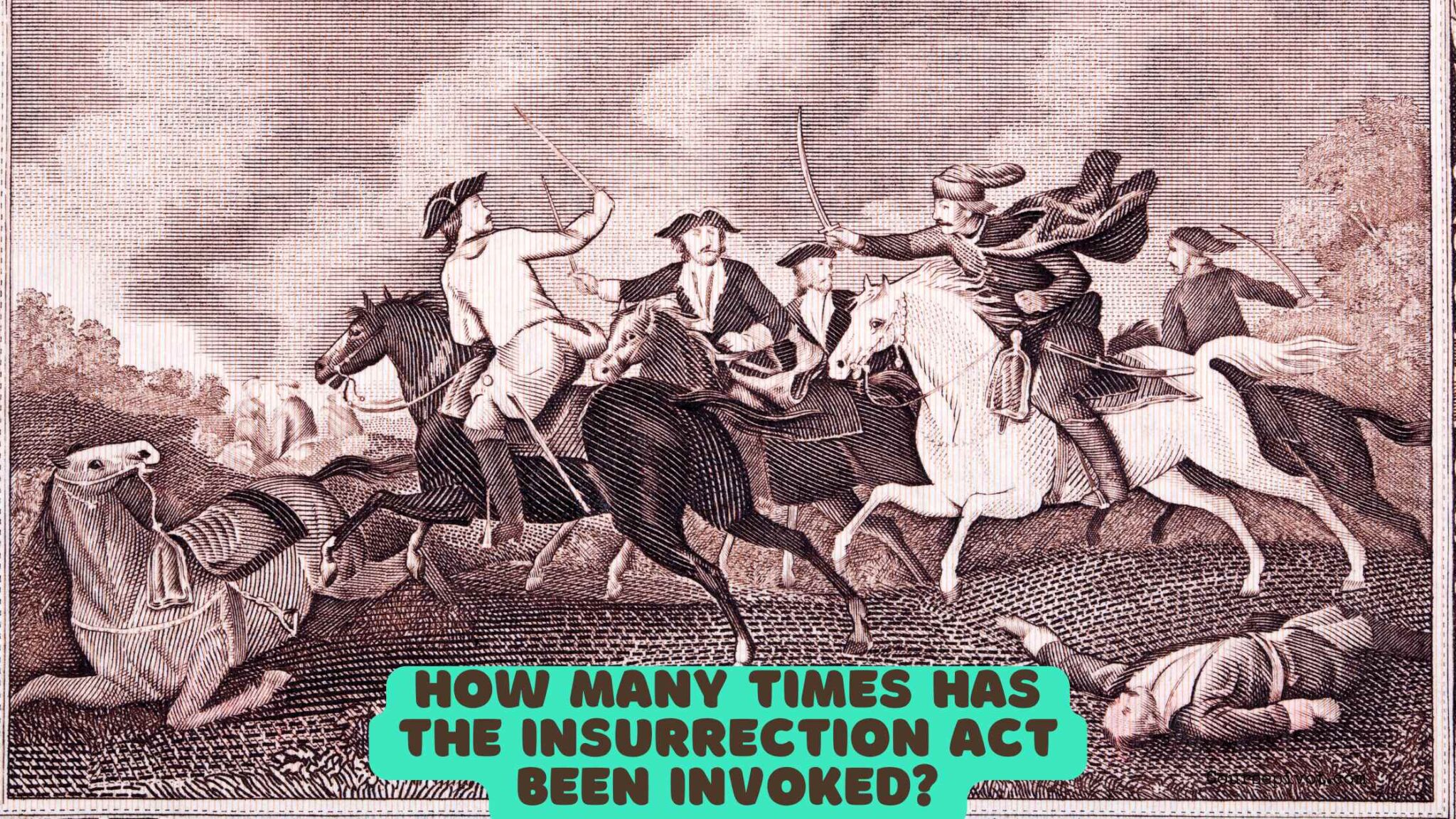
The Insurrection Act is one of the most significant and least understood powers in the American presidency. It authorises the Commander-in-Chief to deploy military forces inside the United States — bypassing the normal constitutional restrictions on domestic military operations — under specific conditions. The question of how many times it has actually been invoked is surprisingly contested, partly because of differing definitions of what counts as a formal invocation, and partly because the historical record before the twentieth century is fragmentary.
The most rigorous congressional research suggests the Act has been formally invoked approximately 30 times since its original passage in 1807, though some counts reach higher depending on how individual executive orders and proclamations are grouped. What is not contested is that the pattern of invocations reveals a great deal about which kinds of crises American presidents have historically judged severe enough to warrant military domestic deployment — and which crises they have chosen to handle by other means.
Q: Has the Insurrection Act ever been used against political protesters? A: Yes — the most prominent example is the 1894 Pullman Strike, when President Grover Cleveland deployed federal troops over the objection of Illinois Governor John Altgeld, who had not requested federal assistance and explicitly opposed it. The Supreme Court upheld Cleveland’s authority in In re Debs (1895). Later invocations during the civil rights era were used not to suppress protests but to protect the constitutional rights of Black Americans against state-sanctioned obstruction — a fundamentally different use of the same statutory authority.
1. What Is the Insurrection Act and Where Does Its Authority Come From?
The Insurrection Act, now codified at 10 U.S.C. §§ 251–255, traces its origins to the Calling Forth Act of 1792, passed during the Washington administration. The current statute was substantially consolidated in 1807 during the Jefferson administration, with significant amendments in 1861, 1871, and most recently 2006 (the last of which expanded presidential authority before being partially rolled back by Congress in 2008).
The Act operates as an exception to the Posse Comitatus Act of 1878, which generally prohibits the use of federal military forces for domestic law enforcement. Where Posse Comitatus creates the default prohibition, the Insurrection Act creates the statutory exception. Under 10 U.S.C. § 252, a president may call out the armed forces when a state requests federal assistance to suppress an insurrection. Under § 253, the president may act unilaterally — without a state’s request or consent — when domestic violence, unlawful combinations, or conspiracies obstruct the execution of federal law or deprive citizens of constitutional rights.
The § 253 authority is the more controversial provision, as it permits the federal executive to override a state government’s preference not to receive military assistance. This provision was added in its current form by the Enforcement Act of 1871, aimed specifically at Ku Klux Klan violence in the post-Civil War South.
2. The Early Invocations: Jefferson Through the Civil War Era
1806–1807 (Jefferson — Burr Conspiracy): Thomas Jefferson issued a proclamation calling on participants in Aaron Burr’s alleged conspiracy to disperse, and authorised the use of military force in the Orleans Territory. This is among the earliest exercises of what would be formally codified as Insurrection Act authority in 1807.
1808 (Jefferson — Embargo Enforcement): Jefferson used militia and federal forces to enforce the Embargo Act of 1807 along the northern border with Canada, where resistance to the embargo was widespread. This is sometimes listed as a separate invocation.
1842 (Tyler — Dorr Rebellion, Rhode Island): Rhode Island had two competing governments — the established charter government and Thomas Dorr’s rebel government — each claiming legitimacy. President John Tyler issued a proclamation warning that federal forces would support the established government against insurrection, effectively ending the Dorr Rebellion without requiring actual deployment.
1856–1858 (Pierce and Buchanan — Bleeding Kansas): Presidents Franklin Pierce and James Buchanan used federal troops repeatedly in Kansas Territory during the violent conflict between pro-slavery and anti-slavery settlers. Pierce’s 1856 proclamation ordering armed groups to disperse is among the formally counted invocations.
1871 (Grant — KKK Suppression in South Carolina): Ulysses S. Grant invoked the Act — specifically the new § 253 authority just added by the Enforcement Act — to suspend habeas corpus and deploy federal troops against Ku Klux Klan violence in nine South Carolina counties. This remains one of the most constitutionally significant invocations, establishing that the president could act without state consent to protect citizens’ federal constitutional rights.
3. The Labor Unrest Period: Cleveland to Wilson
1894 (Cleveland — Pullman Strike): President Grover Cleveland’s invocation during the Pullman railroad strike is among the most studied and most contested in the Act’s history. Cleveland deployed federal troops to Chicago and other rail centres despite the explicit objection of Illinois Governor Altgeld. The justification was obstruction of the U.S. mail rather than insurrection in the traditional sense. The Supreme Court’s subsequent decision in In re Debs broadly affirmed presidential authority to use military force to keep interstate commerce and mail delivery operating.
1906 (Roosevelt — San Francisco earthquake aftermath): Theodore Roosevelt deployed federal troops to San Francisco following the earthquake and fire, authorising them to assist in law enforcement and shoot looters if necessary. Whether this constitutes a formal Insurrection Act invocation is debated among historians, but it is included in some counts.
1914 (Wilson — Colorado Coalfield War): Woodrow Wilson deployed federal troops to Colorado in the aftermath of the Ludlow Massacre, in which Colorado National Guardsmen killed striking mine workers and their families. The federal deployment was intended to disarm both sides and restore order — a notable case where federal military authority was used in part to constrain the actions of a state’s own National Guard.
1919 (Wilson — Race riots in multiple cities): Wilson deployed federal forces during race riots in several cities, including Omaha, Nebraska (following a lynching) and Washington D.C. The 1919 “Red Summer” saw widespread racial violence across the country, and federal deployments occurred at multiple points.
4. The Civil Rights Era: Eisenhower, Kennedy, and Johnson
The civil rights era produced the most widely remembered invocations of the Insurrection Act, and they share an important structural feature: in each case, the Act was invoked to enforce federal constitutional rights against state governments that were actively obstructing them.
1957 (Eisenhower — Little Rock, Arkansas): After Arkansas Governor Orval Faubus used the Arkansas National Guard to block the integration of Little Rock Central High School — in defiance of the Supreme Court’s Brown v. Board of Education ruling — President Eisenhower federalised the Arkansas National Guard and sent the 101st Airborne Division to escort the nine Black students into the school. This is the clearest modern example of the Act being used to enforce federal constitutional rulings against state resistance.
1962 (Kennedy — University of Mississippi): President Kennedy deployed over 30,000 federal troops and federalised the Mississippi National Guard to enforce the court-ordered admission of James Meredith to the University of Mississippi. Two people were killed in riots before order was restored.
1963 (Kennedy — University of Alabama): Kennedy again federalised the Alabama National Guard to enforce the court-ordered integration of the University of Alabama, after Governor George Wallace’s theatrical “stand in the schoolhouse door.”
1965 (Johnson — Selma to Montgomery marches): President Johnson federalised the Alabama National Guard to protect the Selma to Montgomery voting rights march after the state had used its own National Guard and state troopers to attack marchers on Bloody Sunday.
1967 (Johnson — Detroit and Newark riots): Johnson deployed federal troops to both Detroit and Newark during major urban uprisings. The Detroit deployment — over 47,000 federal soldiers and National Guardsmen — was the largest domestic military mobilisation since the Civil War. The riots resulted in 43 deaths in Detroit alone.
1968 (Johnson — post-assassination riots): Following the assassination of Martin Luther King Jr., riots broke out in over 100 American cities. Johnson deployed federal troops to Washington D.C., Chicago, and Baltimore. The 1968 deployments represent the last time federal combat troops were used for large-scale domestic law enforcement in American cities — a benchmark that held for over fifty years.
5. The Late 20th Century: George H.W. Bush and the LA Riots
1989 (Bush — U.S. Virgin Islands, Hurricane Hugo): George H.W. Bush invoked the Act to deploy federal troops to the U.S. Virgin Islands following Hurricane Hugo, in response to widespread looting and breakdown of civil order. The governor of the Virgin Islands had requested federal assistance, making this a § 252 invocation (state-requested rather than unilateral).
1992 (Bush — Los Angeles riots): Following the acquittal of the officers involved in the Rodney King beating, riots broke out across Los Angeles. After California Governor Pete Wilson requested federal assistance, President Bush invoked the Act and deployed both active-duty soldiers and Marines alongside federalised National Guard forces. Approximately 13,500 active-duty troops were deployed. The invocation is significant as the most recent use of the Act to deploy regular federal military forces in a major American city.
6. Near-Invocations: When Presidents Considered but Declined
The history of near-invocations is as revealing as the invocations themselves, because it shows the political and legal calculations presidents make when deciding whether to cross the threshold.
2005 (Bush — Hurricane Katrina): President George W. Bush reportedly considered invoking the Act to deploy federal forces to Louisiana during the catastrophic response to Hurricane Katrina, but was unable to get Governor Kathleen Blanco’s agreement on the terms of any federal role. The failure to deploy in a timely fashion became one of the defining failures of the Bush administration’s second term. Congress subsequently amended the Act in 2006 to expand unilateral presidential authority — amendments that were then substantially rolled back in 2008 following bipartisan concern about executive overreach.
2020 (Trump — George Floyd protests): President Trump publicly threatened to invoke the Insurrection Act during the nationwide protests following the killing of George Floyd, and military and civilian officials prepared deployment plans. After Chairman of the Joint Chiefs Mark Milley appeared in Lafayette Square in military attire following the forcible dispersal of protesters, he publicly apologised and stated it had been a mistake. Trump ultimately did not formally invoke the Act, though National Guard forces from multiple states were deployed to Washington D.C. under separate authority.
The 2020 near-invocation was the most publicly debated since the civil rights era, partly because Trump’s stated justification — using military force to respond to protests, rather than to protect protesters’ rights — would have represented a fundamental inversion of how the Act had been used in its most prominent historical applications.
7. The Total Count: How Many Times Has It Actually Been Used?
The Congressional Research Service, in its most comprehensive analysis, has identified approximately 30 formal invocations of the Insurrection Act and its predecessor statutes since 1792. Some analyses count higher — up to 40 or more — depending on whether individual proclamations within a single crisis are counted separately (as in the multiple deployments during 1967–1968) and whether territorial deployments (Hawaii, Puerto Rico, the Virgin Islands) are included alongside the 50 states.
The key invocations by era:
- 1792–1800s: 4–6 invocations (Whiskey Rebellion, Burr Conspiracy, Embargo enforcement)
- 1830s–1870s: 6–8 invocations (Dorr Rebellion, Bleeding Kansas, KKK suppression)
- 1890s–1919: 6–8 invocations (Pullman Strike, Colorado coalfields, 1919 race riots)
- 1943–1968: 8–10 invocations (WWII-era race riots, civil rights crisis deployments)
- 1989–1992: 2 invocations (Virgin Islands, LA riots)
No president since George H.W. Bush has formally invoked the Act as of 2026, making the current gap the longest in modern American history.
8. What the Pattern of Invocations Reveals
Looking at the full historical record, three consistent patterns emerge. First, the Act has most often been invoked to address failures of state governance — either because a state government has lost control of a situation (race riots, natural disasters, labor unrest) or because a state government is itself the source of the constitutional violation (civil rights era). Second, invocations cluster around periods of social upheaval — the post-Civil War Reconstruction, the labor conflicts of 1890–1920, and the civil rights movement of the 1950s–60s. Third, the Act’s reach has been contested every time it is used: nearly every major invocation has generated immediate legal challenge or political controversy over whether the threshold for deployment was actually met.
The statutory language provides relatively broad presidential discretion — “whenever the President considers that unlawful obstructions” exist is a famously permissive standard. What has historically constrained that discretion is not legal precision but political cost, military culture, and norms about the appropriate relationship between civilian governance and military force.
For further context on the constitutional balance of power that shapes how the Insurrection Act fits into American governance, 5 reasons why power sharing is desirable examines why distributing authority across institutions — rather than concentrating it — tends to produce more stable and accountable governance. And for a look at another area where law and individual rights intersect in high-stakes ways, 10 good reasons to get out of jury duty explores the legal framework around civic obligations that citizens can legitimately decline.