

5 Reasons for the Collapse of the Soviet Union
The Soviet Union collapsed because long-term economic, political, social, and national tensions finally became impossible to control.
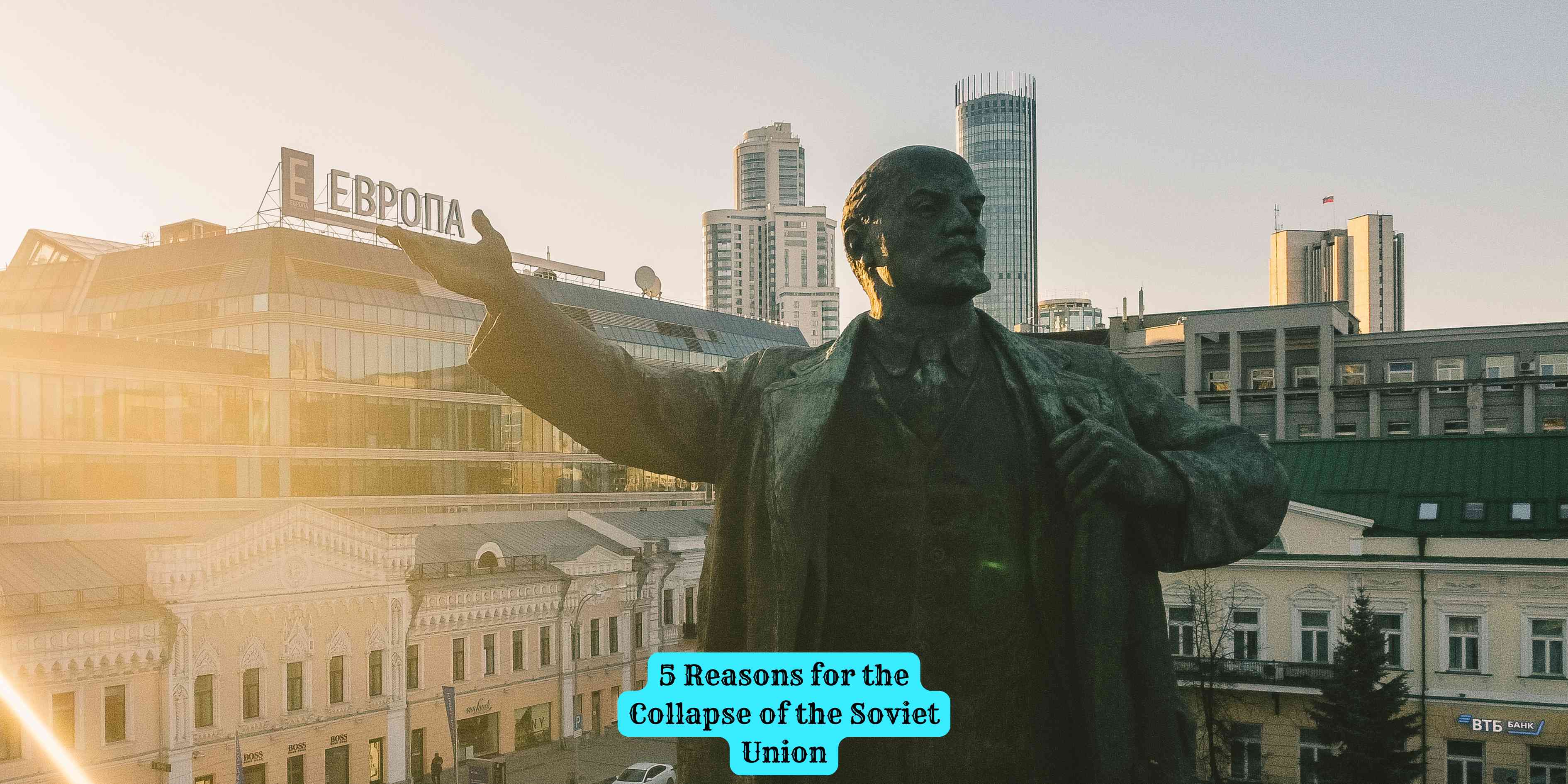
The collapse of the Soviet Union in 1991 was one of the most important events of the twentieth century. It ended the Cold War, reshaped global politics, and led to the independence of fifteen republics that had once belonged to the USSR. Although the breakup seemed sudden to many people at the time, its causes had been building for decades.
The Soviet Union did not collapse for one simple reason. It fell because economic problems, political reforms, nationalist movements, military pressure, and public frustration all came together. Understanding these causes helps explain why a superpower with nuclear weapons, a huge military, and global influence could still fall apart from within.
1. A Weak and Inefficient Economy
One major reason for the collapse of the Soviet Union was its struggling economy. The Soviet system was based on central planning, meaning the government controlled production, prices, wages, and investment. In theory, this allowed the state to direct resources toward national goals. In practice, it often created waste, shortages, and poor-quality goods.
Factories had targets to meet, but those targets did not always match what people actually needed. Managers were rewarded for producing quantity, not necessarily useful or high-quality products. This led to situations where goods existed on paper, but ordinary citizens still waited in long lines for basic items.
The Soviet economy also struggled to innovate. Because businesses were state-run and competition was limited, there was less pressure to improve products, reduce costs, or respond to consumers. Over time, the USSR fell behind many Western countries in technology, productivity, and living standards.
A powerful military could not hide the fact that everyday economic life in the Soviet Union was becoming frustrating, inefficient, and increasingly difficult to sustain.
2. Costly Military Spending and the Arms Race
The Cold War arms race placed enormous pressure on the Soviet economy. The USSR spent heavily on nuclear weapons, conventional forces, military research, and support for allied governments around the world. Competing with the United States required resources that could have been used for housing, consumer goods, agriculture, healthcare, and infrastructure.
Military spending did help the Soviet Union maintain superpower status, but it came at a high cost. The country had to support a huge defense industry while also trying to meet the needs of its citizens. This imbalance became harder to manage as economic growth slowed.
The Soviet war in Afghanistan, which began in 1979, added even more pressure. It cost money, damaged morale, and created public anger as soldiers returned wounded or did not return at all. For many citizens, the war became a symbol of poor leadership and unnecessary sacrifice.
By the 1980s, the Soviet Union was trying to act like a global superpower while its domestic economy was weakening. That gap between ambition and reality became increasingly dangerous.
3. Gorbachev’s Reforms Changed the System
Mikhail Gorbachev became leader of the Soviet Union in 1985 and introduced major reforms to save the system. His two best-known policies were perestroika and glasnost. Perestroika meant restructuring the economy and government, while glasnost meant greater openness in public discussion, media, and politics.
Gorbachev hoped these reforms would make socialism more efficient and honest. Instead, they exposed how serious the country’s problems had become. People began openly criticizing corruption, shortages, environmental disasters, political repression, and the failures of previous leaders.
Glasnost was especially powerful because it weakened fear. Once citizens could discuss problems publicly, it became harder for the Communist Party to control the national conversation. People who had stayed silent for years began demanding more rights, more accountability, and more local control.
Perestroika also disrupted the economy without fully replacing the old system. The Soviet Union moved away from strict central planning, but it did not successfully create a stable market economy. This created confusion, shortages, and uncertainty.
4. Nationalism Grew Across the Soviet Republics
The Soviet Union was not one single ethnic nation. It was a union of many republics, including Russia, Ukraine, Belarus, Lithuania, Latvia, Estonia, Georgia, Armenia, Kazakhstan, and others. Many people in these republics had their own languages, cultures, histories, and national identities.
For decades, the central government in Moscow used political control to keep the union together. But when Gorbachev’s reforms allowed more openness, nationalist movements grew stronger. People in several republics began asking why decisions about their future should be made by Soviet leaders in Moscow.
The Baltic republics, especially Lithuania, Latvia, and Estonia, became important centers of independence movements. Other republics also pushed for sovereignty, local control, or full independence. As these demands grew, the Soviet government had fewer tools to stop them without returning to harsh repression.
Nationalism weakened the idea that the Soviet Union was a permanent political family. More and more republics began to see independence as possible, and eventually as necessary.
5. Loss of Public Trust in the Communist Party
The Soviet system depended heavily on the authority of the Communist Party. For years, the party claimed it represented workers, progress, equality, and the future. But by the 1980s, many citizens no longer believed those claims.
People saw corruption among officials, shortages in stores, censorship in public life, and a gap between government promises and everyday reality. The Chernobyl nuclear disaster in 1986 also damaged public trust because the government’s slow and secretive response showed how dangerous official silence could be.
As trust declined, the Communist Party lost its ability to inspire loyalty. People obeyed less because they believed in the system and more because the system had power. Once that power weakened, obedience weakened too.
When hardline Communist leaders tried to remove Gorbachev in an attempted coup in August 1991, the move failed and further damaged the party’s authority. Soon after, several republics moved decisively toward independence, and the Soviet Union formally dissolved in December 1991.
Why the Collapse Matters
The collapse of the Soviet Union mattered because it changed the world map and the balance of global power. The United States emerged from the Cold War as the dominant superpower, while former Soviet republics faced the difficult task of building new political and economic systems.
The collapse also showed that military strength alone cannot preserve a state. A country also needs a functioning economy, legitimate institutions, public trust, and a political system that can respond to change.
Final Thoughts
The Soviet Union collapsed because its internal weaknesses became too great to manage. Economic inefficiency, military pressure, political reform, nationalist movements, and loss of public trust all worked together. No single cause explains everything, but together they created a crisis the system could not survive.
For students of history, the lesson is clear: powerful states can appear stable while deep problems grow beneath the surface. When those problems are ignored for too long, even a superpower can fall apart quickly.