

5 Major Reasons for Poverty in India
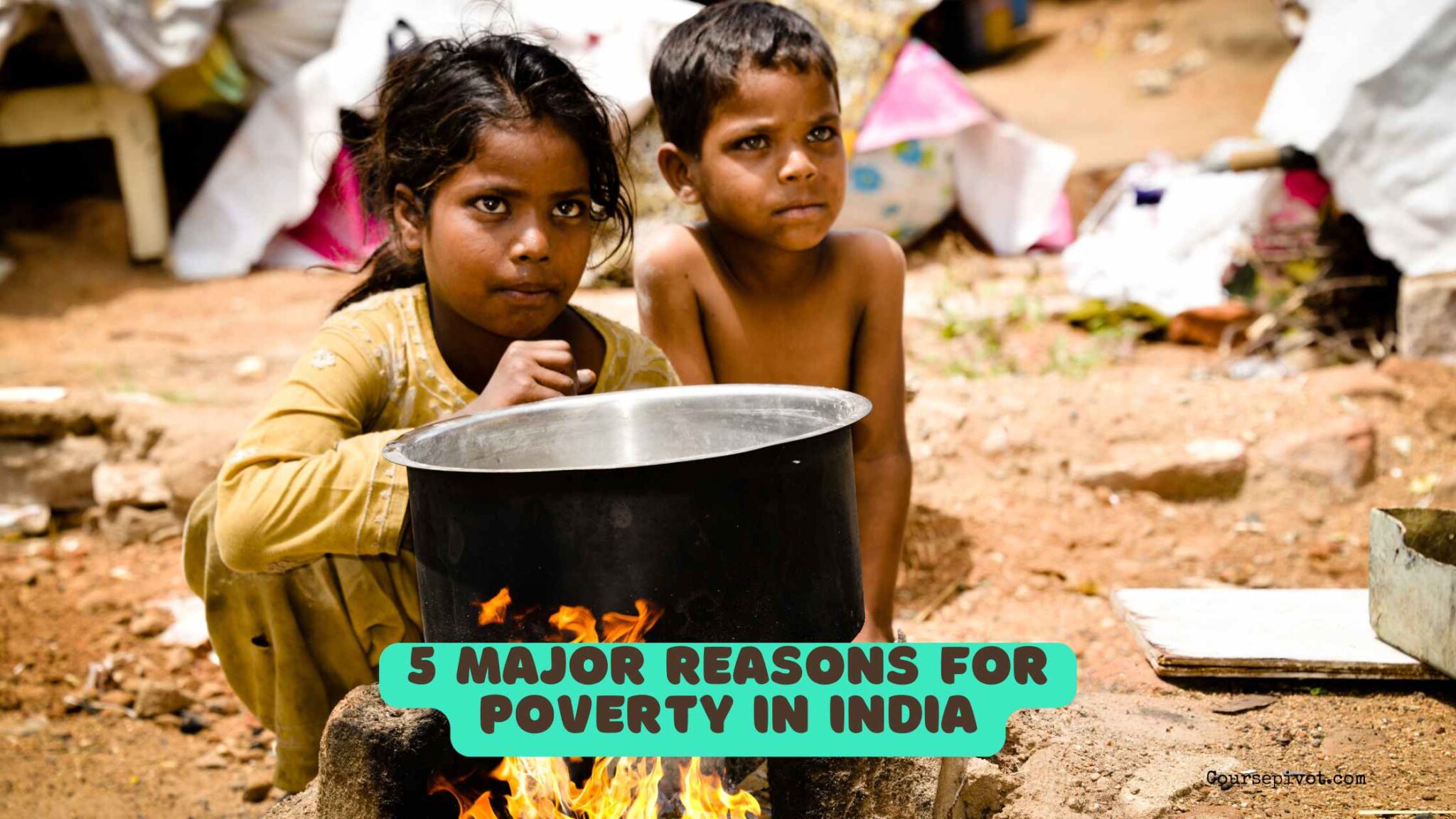
India’s economic story over the past three decades is genuinely remarkable. Since liberalisation in 1991, the country has grown into the world’s fifth-largest economy, lifted hundreds of millions of people out of extreme poverty, and built world-class industries in technology, pharmaceuticals, and services. By almost any aggregate measure, India is economically stronger than at any point in its history.
And yet poverty — deep, persistent, and structurally entrenched poverty — remains one of India’s defining challenges. Depending on the measure used, between 200 and 370 million Indians still live in poverty. The gap between India’s impressive macroeconomic performance and the lived experience of its poorest citizens is one of the most studied paradoxes in development economics.
Understanding why poverty persists in India despite growth requires going beyond headline GDP figures and examining the structural forces that have shaped inequality and deprivation across generations. This article covers the five most significant of those forces.
Q: Has poverty in India improved over time? A: Yes, significantly — but unevenly. The share of India’s population living in extreme poverty (under $2.15 per day, World Bank standard) has fallen dramatically since the 1990s. India achieved its Millennium Development Goal of halving extreme poverty ahead of schedule. However, multidimensional poverty — which accounts for education, health, and living standards alongside income — remains high, and gains have been distributed very unequally across states, castes, genders, and urban-rural divides. Progress at the national level can mask persistent deprivation at the local and household level.
1. Structural Inequality Rooted in the Caste System
No analysis of poverty in India is honest without addressing the caste system and its continuing economic consequences. The caste system — a hierarchical social classification with origins in ancient Hindu society — has historically determined what occupations people could perform, who they could marry, where they could live, and what social and economic resources they could access. Though caste-based discrimination is prohibited by the Indian Constitution and subject to legal protections, its structural legacy remains deeply embedded in economic outcomes.
Scheduled Castes (Dalits) and Scheduled Tribes — historically the most marginalised groups — continue to face significantly higher poverty rates than upper-caste populations. They are overrepresented in informal, low-wage, and manual labour occupations; underrepresented in high-earning professions, business ownership, and higher education; and more likely to face discrimination in labour and credit markets that limits their economic mobility regardless of their individual qualifications or effort.
Land inequality is part of this story. Following independence, land reform efforts were incomplete and unevenly implemented across states. In many rural areas, landholding patterns still reflect historical caste hierarchies — with dominant castes retaining disproportionate ownership of agricultural land while Dalits and tribal communities remain landless or near-landless agricultural labourers.
The persistence of caste-based poverty illustrates why economic growth, on its own, does not automatically reduce structural inequality. Growth can raise average incomes while leaving the relative position of marginalised groups largely unchanged — particularly when the mechanisms of exclusion operate at the social and institutional level rather than the purely economic one.
2. Rapid Population Growth and a Young, Underemployed Workforce
India’s population — approximately 1.44 billion as of 2024, surpassing China to become the world’s most populous nation — is both an economic opportunity and a developmental challenge. The opportunity is the demographic dividend: a large working-age population that, if productively employed, can generate significant economic output. The challenge is that India has not yet consistently generated enough high-quality formal employment to absorb the approximately 12 million young people who enter the labour market every year.
The result is a large and growing informal sector — jobs that are low-productivity, low-wage, insecure, and outside the social protection systems (including employment insurance, pension schemes, and health coverage) that formal employment provides. Approximately 90% of India’s workforce is informally employed. These workers are economically active — they are not unemployed in the conventional sense — but they are caught in low-productivity, low-income work with limited prospects for advancement.
India’s poverty challenge is increasingly a problem of employment quality rather than employment quantity. The country does not lack workers — it lacks enough jobs that pay wages sufficient to lift households permanently out of poverty and provide the stability and benefits that convert income gains into lasting welfare improvements.
The informal sector’s dominance has structural roots: labour regulations that create strong incentives for firms to remain small (below thresholds that trigger formal employment obligations), skills mismatches between the education system’s output and the labour market’s needs, and infrastructure constraints that limit private sector expansion in manufacturing — the sector that historically drives formal employment growth in developing economies.
3. Inadequate Access to Quality Education and Healthcare
Poverty and human capital deprivation reinforce each other in cycles that are difficult to break without deliberate intervention. Children born into poor households are less likely to receive quality education, more likely to suffer from malnutrition that impairs cognitive development, more likely to leave school early to contribute to household income, and less likely to access the healthcare that keeps adults productively employed. The next generation inherits the same disadvantages.
India’s education system has made significant quantitative progress — school enrolment rates at the primary level are now very high — but quality remains deeply unequal. Government schools in rural and low-income urban areas frequently suffer from poor infrastructure, teacher absenteeism, overcrowded classrooms, and weak curricula. Annual learning assessments (ASER reports) consistently show that a significant proportion of children in government schools cannot read a basic text or perform simple arithmetic at grade level, even after several years of schooling. The private school sector provides higher quality for those who can pay, but that payment is out of reach for the poorest households.
Healthcare access follows a similar pattern. India’s public health infrastructure is significantly under-resourced relative to the country’s size and need. Out-of-pocket health expenditure is among the highest in the world as a proportion of total health spending — meaning that a serious illness routinely pushes households into poverty or deeper into poverty. The absence of comprehensive public health insurance for the majority of the population until recent years (the Ayushman Bharat scheme, launched in 2018, represented a significant though still incomplete step toward universal coverage) has meant that health shocks are a major driver of poverty transitions in India.
4. Agricultural Distress and Rural Underdevelopment
Approximately 65% of India’s population still lives in rural areas, and agriculture — despite contributing only around 17% of GDP — remains the primary livelihood for roughly half the workforce. This structural mismatch between agricultural employment share and agricultural output share is itself an indicator of low agricultural productivity, and the consequences for rural poverty are severe.
Indian agriculture faces multiple intersecting challenges:
Fragmented landholdings: As land is divided between heirs across generations, the average farm size has shrunk to below 1 hectare in many states. Small farms cannot easily achieve the economies of scale that modern agricultural machinery and technique require, limiting productivity and income.
Irrigation dependence and climate vulnerability: More than half of India’s agricultural land is rain-fed rather than irrigated. Monsoon variability — which is increasing in intensity and unpredictability with climate change — creates year-to-year income volatility for farmers that makes sustained poverty reduction extremely difficult. A bad monsoon does not merely reduce income in one year; it triggers debt cycles from which small farmers often cannot recover.
Agricultural debt and farmer distress: A significant proportion of India’s farmers are caught in cycles of debt — to moneylenders, microfinance institutions, or cooperative banks — incurred to finance seeds, fertilisers, and equipment. When harvests disappoint or commodity prices fall, this debt becomes unpayable. India has witnessed thousands of farmer suicides annually for decades, primarily concentrated in states with high cash-crop dependence (Maharashtra, Andhra Pradesh, Punjab), in a tragedy directly connected to agricultural debt distress.
Limited market access and price exploitation: Small farmers often lack access to markets where they could sell their produce at fair prices. Middlemen and market intermediaries capture a significant share of the value between farm gate and consumer, leaving farmers with a small fraction of the final price paid for their output.
5. Governance Deficits, Corruption, and Uneven Policy Implementation
India has a comprehensive legal and constitutional framework for addressing poverty: reservation policies for historically marginalised groups, rural employment guarantee schemes, food security legislation, housing programmes, and extensive social protection infrastructure. The gap between policy design and policy delivery — between what these programmes promise and what they actually deliver to the intended beneficiaries — is one of the most significant structural drivers of persistent poverty.
Corruption at multiple levels of government — from senior officials who divert programme funds to local bureaucrats who extract bribes in exchange for benefits that are legally free — systematically reduces the effectiveness of poverty-reduction expenditure. Studies of India’s food distribution system, rural employment guarantee scheme (MGNREGA), and various state-level welfare programmes have all found significant leakage between allocation and delivery.
Beyond corruption, governance deficits include weak administrative capacity in precisely the states where poverty is most acute (Uttar Pradesh, Bihar, Madhya Pradesh, and Jharkhand consistently rank among both the poorest and the most administratively challenged states), poor coordination between central and state government programmes, and political incentives that favour visible short-term spending over the longer-term investments in infrastructure, education, and institutional capacity that produce sustained development.
The relationship between governance quality and poverty outcomes in India’s states is striking: states that have invested in administrative capacity, accountability mechanisms, and effective public service delivery — Kerala being the most cited example — have achieved human development outcomes that dramatically outperform their income levels, while states with weak governance have persistently high poverty rates even when they have access to significant central funding.
The federal structure of Indian governance means that poverty reduction is ultimately a state-level challenge as much as a national one. The central government can design programmes and allocate resources, but it is state governments that determine whether those resources reach the intended beneficiaries. In this sense, why power sharing and accountability mechanisms matter in governance is not an abstract political science question — in India’s context, it is directly connected to whether poverty programmes actually reduce poverty.
India’s poverty challenge is not a single problem with a single solution. It is an interlocking system of structural disadvantages — historical, demographic, agricultural, educational, and institutional — that reinforce each other and require simultaneous attention. The same analytical framework that helps explain poverty in India — examining structural constraints rather than individual failings — applies when understanding what drives unemployment and what economic indicators reveal about development. In each case, the aggregate numbers only become useful when you understand the mechanisms underneath them.