

20 Things We Can Only Inherit from Our Dads
Some things come from mom. Some things come from dad. And some things — genetic, physical, and behavioral — only travel through the paternal line. Here are 20 of them.
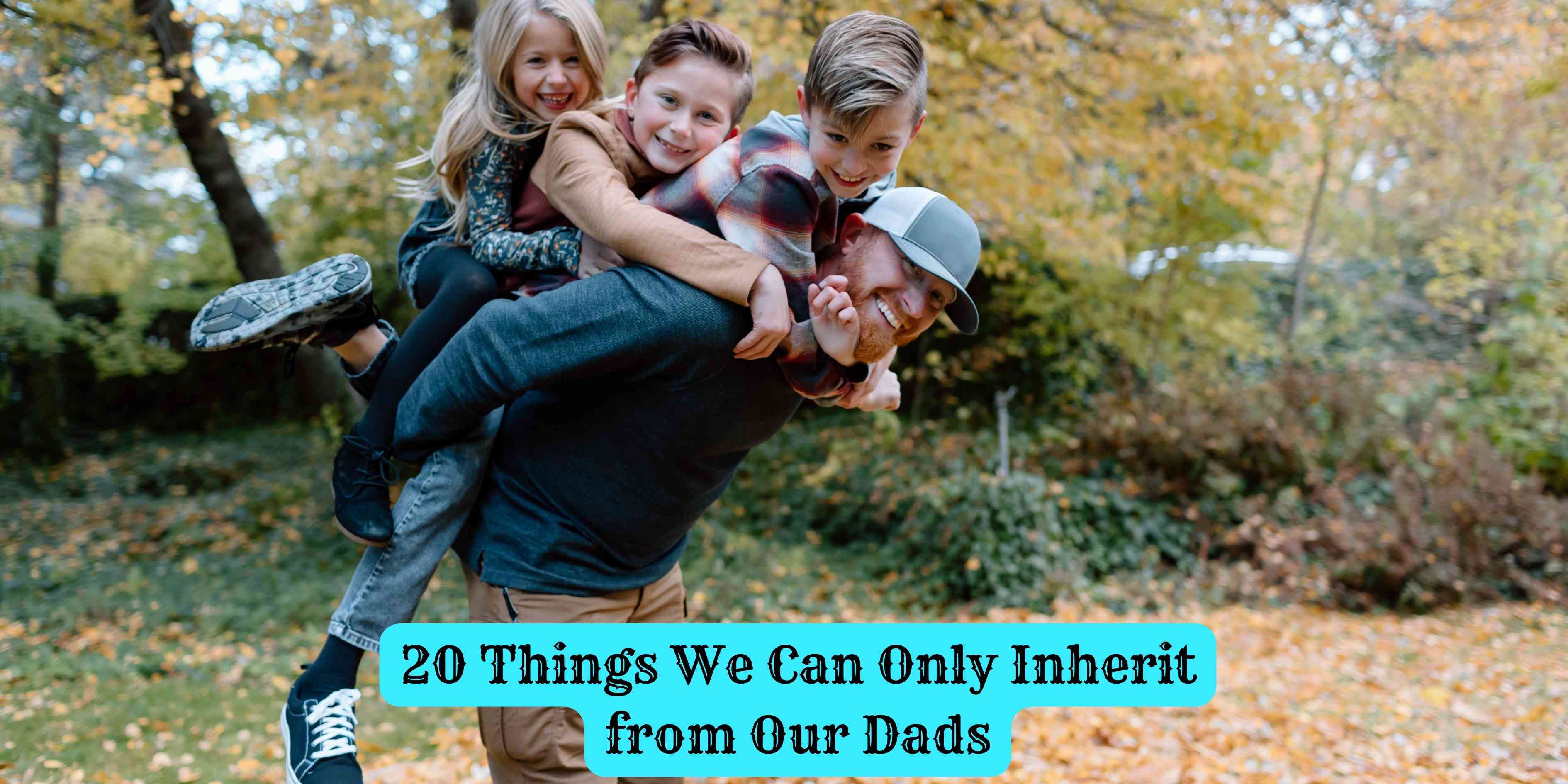
Genetics is a co-production — roughly half our DNA comes from each parent. But not everything is split evenly. Some genetic information travels specifically through the paternal line: the Y chromosome is one obvious example, but there are also epigenetic patterns, mitochondrial quirks, and biological tendencies that emerge primarily from the father’s side. And beyond the purely genetic, there are behavioral tendencies, values, and life perspectives that fathers uniquely model and transmit. These 20 cover both the biological and the human.
What Biology Passes Through Dad
1. The Y chromosome (if you’re male) The Y chromosome — which determines biological maleness — passes exclusively from father to son, unchanged through the paternal line. Genetic genealogists use Y-chromosome testing to trace direct paternal ancestry across thousands of years because of this exclusive father-to-son transmission. Every man’s Y chromosome is essentially his father’s, and his father’s father’s, in direct descent.
2. Male-pattern baldness — via the X chromosome, but triggered by the Y side The primary genes for androgenetic alopecia (male-pattern baldness) are carried on the X chromosome (which men inherit from their mothers). But the Y chromosome and the hormonal environment it creates are what determine whether those genes express. If your father went bald, the testosterone-driven expression of the hair loss genes is a paternal inheritance, even if the genes themselves traveled through mom.
3. Paternal mitochondrial DNA (very rarely) Mitochondrial DNA is typically inherited from the mother. However, rare documented cases of paternal mitochondrial DNA transmission have been recorded in the scientific literature. While not a standard inheritance pattern, it has occurred — making paternal mitochondrial inheritance a real, if uncommon, biological phenomenon.
4. Prostate health risk Prostate cancer has a significant hereditary component, and having a father or brother with prostate cancer is one of the strongest risk factors for developing it. The genetic variants most associated with prostate cancer risk travel through family lines, with paternal transmission being particularly relevant to sons.
5. Certain epigenetic patterns Epigenetics involves changes in gene expression that are not changes to the DNA sequence itself but affect how genes are switched on or off. Research has shown that a father’s lifestyle — diet, stress exposure, age at conception — can leave epigenetic marks that are transmitted to children and sometimes grandchildren. A father’s metabolic history, in particular, appears to influence the metabolic tendencies of his children through epigenetic mechanisms.
6. Birth defects associated with advanced paternal age Several genetic conditions — including some cases of autism spectrum disorder, achondroplasia (dwarfism), and Apert syndrome — are associated with de novo (new) mutations that are significantly more likely to originate on the paternal side of the genome. Advanced paternal age increases the frequency of these mutations because sperm cells replicate continuously throughout a man’s life.
7. Facial structure resemblances specific to the paternal line While facial features are contributed by both parents, specific structural patterns — the shape of the nose, the jaw line, the brow — often display strong paternal resemblance. Many families observe consistent paternal facial resemblances running through generations, which reflect the specific polygenic inheritance patterns of the paternal line.
8. Height (partially) Height is polygenic and influenced by both parents. However, research indicates that sons’ height correlates more strongly with the father’s height than with the mother’s. Tall fathers produce proportionally taller sons on average, and the Y chromosome appears to carry some height-influencing variants that affect sons specifically.
What Dads Pass Down Beyond Biology
9. Risk tolerance and financial philosophy Fathers’ attitudes toward financial risk — whether they invest boldly or conservatively, whether they regard debt as a tool or a danger, whether they build or preserve — are modeled to children throughout childhood and substantially shape their own financial dispositions. Sons, in particular, often reproduce their fathers’ financial patterns, sometimes consciously but often without realizing it.
10. Relationship with authority A father’s posture toward authority — whether he defers to it, questions it, resents it, or navigates it strategically — is one of the earliest models children encounter for how to relate to systems, institutions, and people in power. This inherited relationship with authority shapes professional trajectories, civic engagement, and life philosophy in ways that are deep and persistent.
11. How to handle failure Whether a father models falling apart in failure, stoic silence, constructive recalibration, or persistent effort after setback — children inherit this template as their first sense of what failure means and what one is supposed to do with it. Many adults, examining their responses to failure, find their father’s voice in what they hear.
12. Work ethic and relationship with labor The visible dedication, pride, or indifference a father brings to his work shapes children’s sense of what effort means, what work is for, and what kind of relationship with labor is normal. Whether a father finds meaning in his work, complains about it constantly, or simply does it without comment — all of these are transmitted as a model.
13. Sense of humor style Humor is significantly social and learned, and fathers are among the primary early models for what is funny, what the rules of humor are, and how to be funny within a family’s specific comedic culture. The dry wit, the physical comedy, the storytelling humor, or the pun orientation — these often reflect the paternal line in recognizable ways.
14. The tendency to “find a way” or “give up” Problem-solving orientation — the degree to which a father modeled perseverance and creative problem-solving versus helplessness or avoidance when things were difficult — becomes a deep template for children’s own response to obstacles. The “we figure it out” or “there’s nothing to be done” disposition of a father is among the most influential things he transmits.
15. Relationship with one’s body and health Whether a father took care of his physical health, ignored symptoms, sought medical care readily or reluctantly, exercised or was sedentary — all of this is modeled to children and shapes their own health-related behaviors and beliefs. The man who never goes to the doctor raises children who do not think of medical care as routine, and vice versa.
16. Communication style in conflict How a father handled disagreement — whether he raised his voice, withdrew into silence, negotiated reasonably, or avoided conflict entirely — is one of the most copied templates in adult relationships. The children of men who withdrew from conflict often find themselves withdrawing; the children of men who escalated often fight for the floor.
17. Capacity for physical affection Whether a father hugged, held, and expressed physical affection openly, or was physically reserved, models for children what physical affection between people who love each other looks like. Men in particular often reproduce their father’s pattern of physical expressiveness — or, recognizing it, deliberately correct it.
18. Relationship with anger Anger expression is one of the most significantly transmitted paternal behaviors. Whether it was modeled as an uncontrolled discharge, a quiet withdrawal, a constructive force, or a dangerous presence — children learn their relationship with their own anger partly by watching their fathers’ relationship with his.
19. Faith and spiritual orientation A father’s genuine religious faith — or genuine absence of it — is one of the most influential determinants of his children’s religious trajectory. The active practice of faith, the cynicism about religion, the nominal observance, the searching — all of these are transmitted as a model that children either adopt, reject, or complicate in their own spiritual formation.
20. The belief that you are capable and worthy Perhaps the most significant inheritance a father can give is the internalized belief that his child is capable of navigating life, worthy of love and respect, and equipped to handle what comes. This belief, transmitted through consistent presence, genuine attention, and a father’s expressed confidence in his child, becomes the child’s relationship with their own potential. Its presence or absence echoes through every subsequent decade.