

10 Responses to Describe Why You Are an Ideal Candidate for This Position During Interview
"Why are you the ideal candidate?" is one of the most common interview questions — and one of the least prepared for. These 10 example responses show you exactly how to answer it effectively.
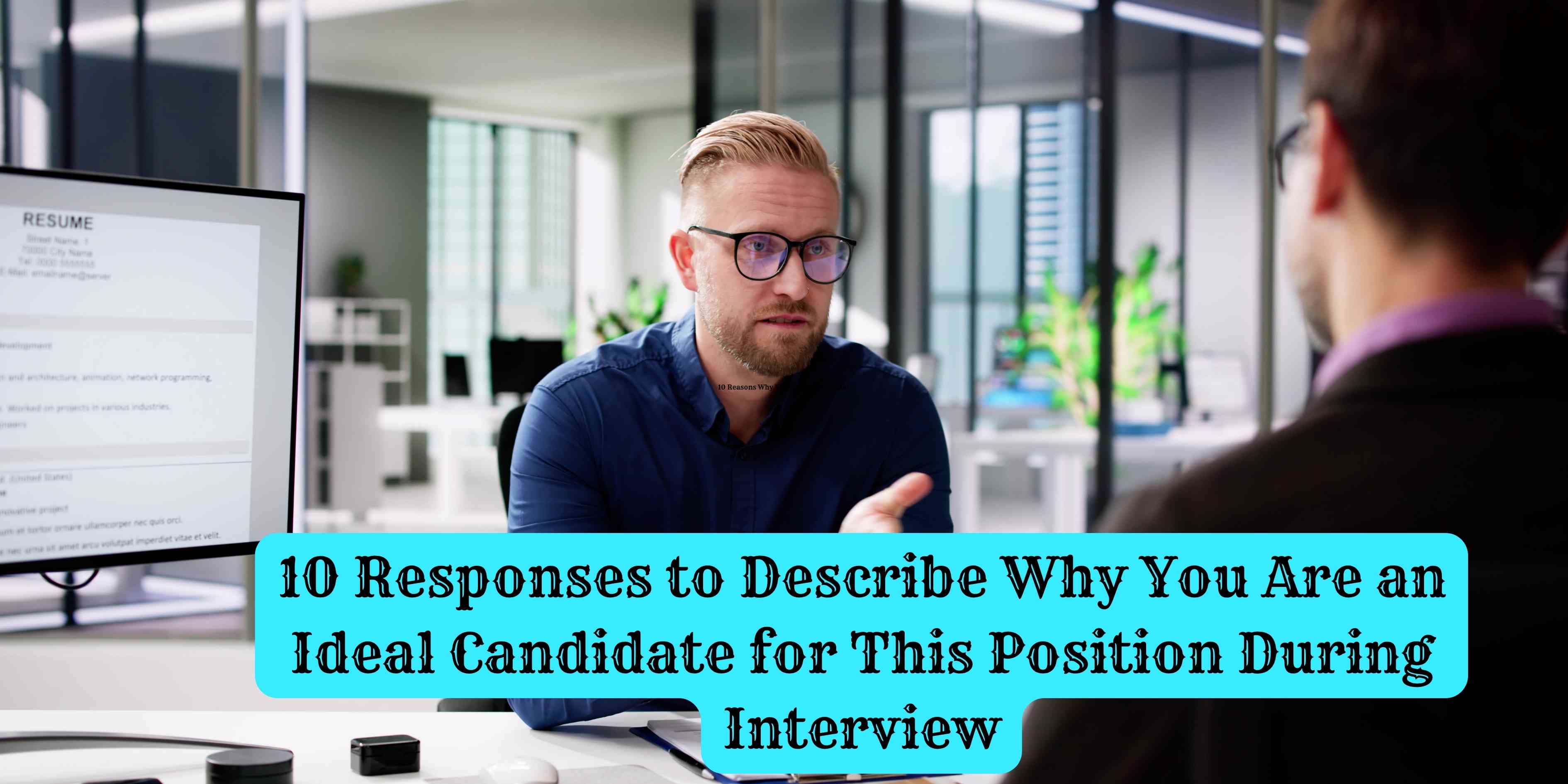
When an interviewer asks “Why are you the ideal candidate for this position?” they are inviting you to make a concise, evidence-based case for yourself. The weakest answers are vague (“I’m a hard worker and a fast learner”), the strongest are specific — naming the key requirements of the role, matching them to your concrete experience, and communicating genuine fit. These ten example responses model that structure across different roles and experience levels.
1. For a Customer Service Role
“I believe I’m a strong match for this role because of my three years of experience handling high-volume customer interactions in a retail environment — including managing escalations and resolving billing disputes without supervisor involvement in the majority of cases. I’ve consistently received above-average satisfaction scores in quarterly reviews, and I’ve developed a specific approach to de-escalation that I’ve trained three new team members on. I understand your company values customer retention as a key metric, and that aligns directly with how I’ve been approaching customer service my entire career.”
Strategy: Match the specific requirement (customer handling, retention focus) to specific evidence (years of experience, metrics, training role).
2. For a Marketing Coordinator Role
“My background combines the analytical and creative skills this role requires in a way that I don’t always see together. On the analytical side, I have hands-on experience managing Google Ads campaigns with a monthly budget of $15,000, where I consistently hit a 4x return on ad spend. On the creative side, I’ve led the content calendar for two brands, producing and scheduling social content that grew follower engagement by 40% over eight months. Your job description emphasizes both performance marketing and brand content, and my experience covers both.”
Strategy: Identify the dual requirement of the role and demonstrate competence in both explicitly.
3. For a Software Development Role
“My technical background is a strong fit for what you need — I’ve spent four years working in the same technology stack you listed (React, Node.js, PostgreSQL), and I’ve contributed to two production applications with active user bases. Beyond the technical match, I have specific experience in the problem area you’re building in: I built a notification and scheduling module at my previous company that solved a similar challenge to the one in your product roadmap. I also understand your company’s engineering culture — I’ve worked in agile environments with two-week sprint cycles and am comfortable with the PR review and documentation standards that entails.”
Strategy: Match technical requirements specifically, then go beyond to demonstrate domain relevance and culture fit.
4. For a Management or Leadership Role
“I’m suited to this role for three reasons that come from my track record rather than just my background. First, I’ve built and managed teams — I grew the customer success team from four to eleven people over two years, which required both hiring and structured onboarding. Second, I’ve managed toward metrics in environments where the team’s output was quantified — our team hit 94% of quarterly targets across six consecutive quarters. Third, I’m the kind of manager who develops people: two of the people I hired have since been promoted to senior roles. That combination of team growth, performance management, and people development is what I understand this role to need.”
Strategy: For management roles, use specific evidence of the three core management dimensions: team building, performance management, and people development.
5. For an Entry-Level Role with No Direct Experience
“I’m applying for this role knowing that I don’t have direct professional experience yet, and I want to be straightforward about what I’m bringing instead. I’ve spent the past two semesters in a relevant internship at a small marketing agency where I managed social media accounts and ran email campaigns — I can speak to real outcomes, not just tasks. I’ve also independently built a portfolio project that applies directly to this role: I created a content strategy and ran it for six months on a personal project, which taught me the same skills you’d need me to apply here. My learning curve will be steeper than an experienced hire, but I’ve shown I can deliver in relevant conditions.”
Strategy: Acknowledge the gap honestly, then demonstrate relevant preparation through internships, projects, or self-directed learning.
6. For a Healthcare or Caregiving Role
“I’ve worked in direct patient care for five years, most recently in a long-term care facility, and I understand both the clinical requirements and the human dimensions of this kind of work. Clinically, I have certification in the procedures your job listing specifies and I’ve worked in environments with acuity levels comparable to yours. On the human side — which I believe matters as much — I’ve consistently been sought out by patients and families for difficult conversations, end-of-life planning discussions, and situations where they felt they needed someone they could trust. Care quality and patient trust are not separate goals; my experience has taught me they reinforce each other.”
Strategy: In caregiving roles, demonstrate both technical competence and the relational qualities that distinguish good care.
7. For a Teaching or Education Role
“What makes me a strong candidate for this position is the combination of content mastery and classroom practice that I’ve developed together. I have a subject-matter background in the area you’re hiring for — I majored in mathematics and hold a master’s in curriculum development — and I’ve spent three years applying it in classrooms at the grade level you’re posting for. Beyond that, I have specific experience with the student population you serve: I’ve worked in Title I schools where differentiated instruction and family engagement required approaches that don’t work in other contexts. The learning challenges your students face are challenges I’ve encountered, made mistakes around, and significantly improved at addressing.”
Strategy: Combine content knowledge, pedagogical experience, and population-specific experience for education roles.
8. For a Sales Role
“My case for this role is in the numbers. In my last position, I consistently closed at 120% of quota over two years — not in an easy market. I was selling into mid-market accounts with six-to-nine-month sales cycles, which is the same complexity level your job description indicates. I also have experience building pipeline from scratch, not just inheriting established accounts — which I understand is part of what this role requires in the early stage. I’ve learned the consultative approach that enterprise sales at this level requires, and I’ve developed a prospecting cadence that generates qualified meetings without burning relationships.”
Strategy: Lead with metrics for sales roles — hiring managers for sales positions want numbers first.
9. For a Creative or Design Role
“My portfolio will show this better than I can in words, but here’s the summary: I’ve worked in brand design for six years, with a significant portion in the industry your company operates in. I understand the visual language of your market, the expectations of your audience, and the constraints that production often imposes on creative ambition. I’ve worked in collaborative environments with cross-functional teams, which means I’m comfortable taking feedback, iterating quickly, and working within timelines that aren’t always comfortable. I’m also genuinely excited by the specific design problems your work involves — I’ve been following your brand for two years and have strong views about where it could go.”
Strategy: For creative roles, acknowledge that the portfolio is primary evidence, then add context about industry knowledge, collaboration, and genuine engagement.
10. For a Career Change or Non-Traditional Background
“My path to this role is not the most direct one, and I think that’s worth addressing directly. I’m changing industries from finance to product management, and I want to explain why I think that’s an advantage rather than a gap. Financial analysis at the level I’ve been working requires structured problem-solving, user research (I was doing market analysis, which is fundamentally the same cognitive work), stakeholder communication, and working with data to make decisions under uncertainty — which is what product work is. I’ve also spent the past year building toward this deliberately: I completed a product management certification, shipped a side project that is currently being used by real users, and spent time embedded with the PM team at my current company as part of a cross-functional initiative. I’m not starting from zero; I’m starting from a different position that adds specific value.”
Strategy: For non-traditional backgrounds, name the gap directly, reframe the transferable skills specifically, and demonstrate deliberate preparation that shows the transition is intentional rather than opportunistic.